Singing the Swedish national anthem

When someone speaks incomprehensibly, an English speaker will be inclined to reference Shakespeare’s Julius Caesar, saying “it was Greek to me”. But what does a Greek finance minister say when no one understands him at Eurogroup negotiations? From an interview with Yanis Varoufakis in the New Statesman:

There was point blank refusal to engage in economic arguments. Point blank. You put forward an argument that you’ve really worked on, to make sure it’s logically coherent, and you’re just faced with blank stares. It is as if you haven’t spoken. What you say is independent of what they say. You might as well have sung the Swedish national anthem – you’d have got the same reply.

Irritating false friends

According to Reuters the German Bundestag member Volker Kaude described the new proposals for the Greek financial crisis from European Commission president Juncker as “irritating”. It’s an odd word choice. It would be quite exceptionally blunt if he had said it. Of course, he didn’t.

Turning to German-language media we see that what he actually said was that he was “einigermaßen überrascht über die irritierenden Aussagen aus Brüssel”. “Fairly surprised by the odd comments from Brussels.” “Irritierend” looks like “irritating”, but its primary meaning — and clearly the one intended here — is something more like “puzzling”. It’s diplomatic for having a range of meanings from neutral to negative. I don’t get it, and I don’t think it’s entirely my fault.

Reuters might need to invest in something more sophisticated than Google for its translations.

Operetta diplomacy

I was somewhere between amused and frightened in skimming Netanyahu’s speech to the US Congress, finding this passage:

We’re an ancient people. In our nearly 4,000 years of history, many have tried repeatedly to destroy the Jewish people. Tomorrow night, on the Jewish holiday of Purim, we’ll read the Book of Esther. We’ll read of a powerful Persian viceroy named Haman, who plotted to destroy the Jewish people some 2,500 years ago. But a courageous Jewish woman, Queen Esther, exposed the plot and gave for the Jewish people the right to defend themselves against their enemies.

The plot was foiled. Our people were saved.

(APPLAUSE)

Today the Jewish people face another attempt by yet another Persian potentate to destroy us.

SPOILER ALERT! How are you going to get people to come to hear the whole megillah in synagogue if you just give away the ending? I love the fact that everyone applauded “The plot was foiled.” And what’s with this “Persian potentate” stuff? I thought the Iranians were supposed to be Islamo-fascists.

Seriously, though, if you’re an Israeli prime minister with a reputation for telling tall tales about your neighbours’ military plans and capacities, and you’re trying to make the case that this time it’s really really serious, maybe you don’t want to reveal right up front that your diplomatic calculations are heavily influenced by a 2500 year old fairy tale with as much inherent plausibility as the plot of HMS Pinafore.

Is Netanyahu auditioning for a bigger role?

Many people are wondering why Israel’s Prime Minister, Binyamin Netanyahu, has decided to wreck Israel’s relationship with its superpower patron, a relationship that has been almost absurdly favourable to Israel, uniquely bipartisan and almost unchallenged within the US political establishment. For years he has appeared to be going out of his way to break this bipartisan link, working to undermine US foreign policy, embarrass the president, and show himself and his government to be allied not with the United States, but with the Republican Party. Why? Is it psychopathology or an ingenious scheme? Or both?

Most people who try to explain it (including those who write articles with titles like The real reason Netanyahu is willing to risk Israel’s relationship with the U.S.) tend to posit that the reason has something to do with Israel: Either he is doing it either out of a genuine belief that Obama’s negotiations with Iran threaten Israel’s survival, so demand desperate measures; or that it is a cynical short-term political calculation, intended to shore up his position with the Israeli electorate, particularly now, two weeks ahead of an election. But what if it has nothing to do with Israel’s future, or Netanyahu’s position in Israel, but with Netanyahu’s position outside of Israel?

My thinking here is inspired by a very insightful comment on Greek politics by Matthew Yglesias:

Normally you would think that a national prime minister’s best option is to try to do the stuff that’s likely to get him re-elected. No matter how bleak the outlook, this is your dominant strategy. But in the era of globalization and EU-ification, I think the leaders of small countries are actually in a somewhat different situation. If you leave office held in high esteem by the Davos set, there are any number of European Commission or IMF or whatnot gigs that you might be eligible for even if you’re absolutely despised by your fellow countrymen. Indeed, in some ways being absolutely despised would be a plus. The ultimate demonstration of solidarity to the “international community” would be to do what the international community wants even in the face of massive resistance from your domestic political constituency.

One constant of Netanyahu’s career has been his (for an Israeli politician) exceptional venality. Of course, Netanyahu (or any Israeli leader) has no future in Europe, or major international bodies; but the US is another very big world, and making himself the pet anti-terrorist Jew of the Republican Party could be a highly remunerative post, far more valuable in Shekels than anything that his home country can offer. And if he ends up destroying Israel in the process, he’s all set up to blame left-wing anti-Semitism allied with Islamo-fascism. It will be brilliant for business.

Divorce or start a world war?

I recently read Christopher Clark’s celebrated book on the initiation of the First World War, The Sleepwalkers. There was a lot in it that was new to me. I’ve never seen an account — even a German account — that portrayed Germany as such a passive, almost innocent and peace-seeking, participant in the events of 1914. Although Clark disclaims an attention to fix blame, I felt very clearly that his account put the blame on French and Russian scheming, with Serbians playing a devious supporting role, and the Austro-Hungarians hapless bunglers.

I was struck by his portrayal of the alliance system as reasonably haphazard and fluid, kind of a square dance where nations just stayed with the partners they happened to be with when the music stopped. In particular, the alliance between Russia and the UK seemed to reflect a common pathology in personal relations:

In the light of continuing Russian pressure on Persia and other peripheral imperial territories, there had been talk of abandoning the Anglo-Russian Convention in favour of a more open-ended policy that would not necessarily exclude a rapprochement of some kind with Germany. This never became Foreign Office policy, but the news that Russian mobilization had just triggered German counter-measures at least temporarily foregrounded the Russian aspect of the growing crisis. British policy-makers had no particular interest in or sympathy for Serbia. This was a war from the east, sparked by concerns remote from the official mind of Whitehall.

We’ve all known couples like this. They’ve been together for years, comfortable but never quite committed. Then a crisis comes, and they have to decide: Do we get married or split up. And often they marry, because splitting just seems too frightening. It usually doesn’t end well.

Freedom fries with milquetoast

I was amused to read that Republicans in the US were attacking President Obama for not dropping everything to fly to France and succor our friend and ally in its time of need.

“This is simply no way to treat our oldest and first ally,” [Rick] Perry told The Washington Post. “President Obama should have stood with France in person, defending Western values in the struggle against terrorism and showing support for the victims of this despicable act of terror,” Perry said.[…]

“Our president should have been there, because we must never hesitate to stand with our allies,” [wrote Ted] Cruz.

Because, we know that if there’s anything Republicans care about more than defending scatological satire targeted particularly at conservative religious figures, it’s the centuries-old alliance, built mutual respect and admiration, with the cheese-eating surrender monkeys petulant prima-donna of realpolitik French.

It’s almost as intense as their abiding love of the Ukraine, for which John McCain attacked Obama’s and Angela Merkel’s response to Russia’s invasion of Crimea last year as “playing into Putin’s hands” and “milquetoast” respectively.

The worst of it is, he can’t even get a side of freedom fries with his milquetoast anymore.

Quotation marks

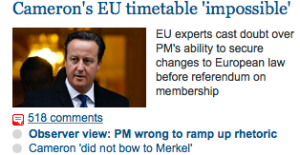
On the Guardian website front page right now is a headline

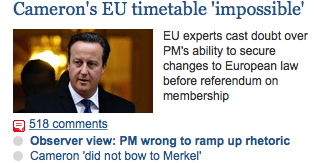
Cameron ‘did not bow to Merkel’

I found this wording interesting, for reasons that I’ll mention below, so I wanted to see who said it. But when I moved to the article, those words were nowhere mentioned. What it says is “The foreign secretary, Philip Hammond, has denied that David Cameron “backed off” over plans to cap migration from the EU after Angela Merkel told him she would not tolerate such an incursion into the principle of the free movement of workers.”

So, did Hammond say “bow”, or “backed off”, or something else entirely? When did quotation marks become acceptable for paraphrases? Or have I missed a subtle development in the distinction between single quotes and double quotes?
Screenshot 2014-11-30 10.26.42

I’m slightly intrigued by the issue of national leaders “bowing” to other leaders, which seems to be particularly influential in political cultures dominated by the culture of schoolboy taunts, as are those of the US and the UK — most especially the UK. I recall the scandal early in the Clinton presidency, when the new president was seen to have bowed to the Japanese emperor.

Administration officials scurried to insist that the eager-to-please President had not really done the unthinkable. “It was not a bow-bow, if you know what I mean,” said Ambassador Molly Raiser, the chief of protocol.

Of course, this was an emperor, not a head of state, and the suggestion was not that Clinton was bowing politically to foreign interests, but rather that he was showing too much obeisance to a monarch, not being true to America’s tradition of colonial independence and steadfast republicanism.

Who would have thought that, barely a decade later, a US president would be attacked by the right wing for his supposed “anti-colonial” roots?

“Continent cut off…”

The news this weekend is dominated by reports of how the entire EU failed last week to reach agreement with David Cameron on the next president of the EU Commission, and had to settle on a compromise candidate, Jean-Claude Juncker, supported only by the non-British faction of the EU. Only Hungary — despite its borderline fascist government — was able to garner Cameron’s support, while the remaining 26 EU members had to make do with the bare consolation of having their preferred candidate take office.

(This was right after soccer teams from many nations were brusquely snubbed by the England side, who could not be persuaded that the quality of the other team’s playing was such as to keep them from attending to other pressing engagements back home.)

Senior Conservatives were not magnanimous toward the defeated EU, accusing other national leaders of “cowardice” for refusing to publicly defame the EU leader whom they had agreed to, and would consequently be working with in the coming years, despite the fact that some of them had not at first considered him their favourite candidate.

Iain Duncan Smith, the Work and Pensions Secretary, said Britons “will be proud that at last they have a Prime Minister who has demonstrated that he puts the interests of Britain first — regardless of who or what is pitted against him.” Perhaps the leader most determined to assert British interests against Europe since King Harold II, who was also famous for keeping his eye fixed (on real reform). They were similarly disdainful of reports that Pope Francis has not completed a conversion to the Anglican Church, and are seeking further investigation of reports that a large ursine has been seen defecating in a forested tract. Continue reading ““Continent cut off…””

The secret government

According to Spiegel, Obama has told Angela Merkel that he knew nothing of “possible eavesdropping” by the NSA on her cell phone — which has been going on for over 10 years — and that he would have stopped it immediately had he known. So we have to assume one of three possibilities:

  1. Obama has decided to double down on the diplomatic affront by baldly lying to the leader of Germany.
  2. Cynics are right: Everyone spies on everyone, and everyone in the higher echelons of government knows about it, so Angela Merkel has felt obliged to collude with Obama to deceive the media and the public.
  3. Obama owes Edward Snowden an apology. The NSA was not working for the US government. It was out of control, slipping the leash of democratic control. Obama was himself naïve to think that he could simply order an investigation. Think back to what Obama said in August about the NSA and Snowden:

And if you look at the reports — even the disclosures that Mr. Snowden has put forward — all the stories that have been written, what you’re not reading about is the government actually abusing these programs and listening in on people’s phone calls or inappropriately reading people’s emails. What you’re hearing about is the prospect that these could be abused… If you are outside of the intelligence community, if you are the ordinary person and you start seeing a bunch of headlines saying, U.S.-Big Brother looking down on you, collecting telephone records, et cetera, well, understandably, people would be concerned. I would be, too, if I wasn’t inside the government…

But people may have better ideas and people may want to jigger slightly sort of the balance between the information that we can get versus the incremental encroachments on privacy that if haven’t already taken place might take place in a future administration, or as technologies develop further…. And so those are the kinds of things that I’m looking forward to having a conversation about.

It’s a typical insider fallacy. He has access to secret information, so he assumes he understands everything that’s going on, far better than the deluded privacy obsessives who have the misfortune of being “outside of the intelligence community”.

So, maybe the president should consider whether it might not have been important after all for a concerned citizen to take matters into his own hands, if even he needed the German news media to let him know what his spooks were up to.

Spying on the UN: The majestic equality of the law

One of the superficial arguments made against Edward Snowden is, He signed a contract, for crying out loud! He agreed not to reveal this information. And he broke the law. So, of course, he belongs in prison.

Let’s talk about some of the other people who violated the contracts they signed and broke the law. People like Barack Obama. Just to pick an example at random, we have today in Der Spiegel (odd that it hasn’t appeared yet in the English-language press, so far as I have seen):

The US clandestine service NSA has been spying not just on the European Union, but also on the United Nations Headquarters. That has been revealed by secret NSA documents that Spiegel has examined.

According to these, the NSA succeeded in the summer of 2012 in penetrating the videoconference system of the community of nations, and to break the encryption. This “dramatically improved the data received from video-teleconferences and the capacity to decrypt these data,” according to one secret NSA document. “These data transmissions deliver to us the internal video-teleconferences of the United Nations (yay!)”. Within three weeks the number of decrypted communications rose from 12 to 458.

The US is committed by treaty not to conduct clandestine operations against the UN or the national representations there. “yay!” indeed. It’s good to see that violations of international treaties are considered with an appropriate level of seriousness within the agency.

So Barack Obama — and his security agents — have violated solemn treaties, ratified by Congress, hence part of the “supreme law of the land”. So do those who break the law definitely belong in prison? What about those who have revealed information that they have pledged to keep secret? Or is there some wiggle room to consider justifications and rationales for breaking the law?