As I have already made clear

I am fascinated by political rhetoric. And while I have been talking a lot about how Trump’s rhetoric breaks the bounds of normal US presidential rhetoric, I’m also interested in the ways in which he pushes the normal to its logical conclusion. To wit, the White House statement Monday on the wave of bomb threats against Jewish institutions:

Hatred and hate-motivated violence of any kind have no place in a country founded on the promise of individual freedom. The President has made it abundantly clear that these actions are unacceptable.

A typical reaction was that of CNN:

 The White House on Monday denounced a spate of threats made against Jewish Community Centers around the country.

For context, this comes after the president explicitly refused to comment last week, and instead attacked the reporter for raising the question. Given that pressure has been placed on the president precisely because he has not made the position of his administration clear, this statement seems less a forthright condemnation of the threats than an explicit refusal to make the president’s position any more “abundantly clear” than he already has.

This is a common political trope, and I’m never sure how to interpret it. I guess it’s supposed to put to rest accusations that one has not yet denounced whatever one was supposed to denounce, while not thereby accepting the accusation that one has failed to denounce it in the past.

But it can come off seeming like another refusal, still giving comfort to those who were supposed to be denounced. That’s especially true in this case, where the statement also fails to say anything about the particulars of these incidents: It condemns violence — in fairly anodyne terms, it must be said — but not threats, which are the particular issue here, and once again refuses to explicitly mention Jews.

They really mean it (a continuing series)

Once again, I am forced to revise my impression of the Trump White House. I assumed that their failure to mention Jews in their statement for International Holocaust Remembrance Day was an oversight, sloppy drafting, which they then had to justify and insist was intentional because Trump. But no:

The State Department drafted its own statement last month marking International Holocaust Remembrance Day that explicitly included a mention of Jewish victims, according to people familiar with the matter, but President Donald Trump’s White House blocked its release.

Together with the Trump administration’s decision that they really don’t like Israeli settlements, I wonder if the right-wing orthodox Jews and Israelis who thought they had the measure of the man are beginning to feel like building contractors on a Trump hotel project.

Political DNA

As someone who actually works with DNA — or, at least, DNA data — I find the drift of the colloquial use of “DNA” disturbing. It’s impossible for me to avoid the resonances of biological determinism, but I’m not sure how other people understand it. I’ve collected a lot of usages, and it seems to have been used in the past to suggest that individuals are being driven by their training or by the historical imperatives of their organisations. Which is sort of fair. But either the meaning is drifting, becoming more crude, or it’s being appropriated for racist purposes.

In this article in yesterday’s Washington Examiner

That Senate Minority Leader Chuck Schumer, D-N.Y., will politicize everything is a given — it’s in his DNA.

Now, I’m pretty sure that the reference to his DNA is not meant to be an ethnic slur. But not completely sure. Why is it there? What is DNA supposed to be adding? Is it his political DNA, his personal DNA (in which case it’s just a redundant statement that this is his immutable characteristic), his family DNA, or his ethnic DNA (which would make it an antisemitic slur). Impossible to say.

Tender-hearted racists

The only place I run into Americans here is in the synagogue. There is one loud-and-proud right-winger who gets treated to a lot of good-humoured deference. This past Sunday, naturally, he was feeling his oats. I mostly stay out of these political discussions, but after listening to him go on and on about the “elitists” in their “bubbles” who had failed to appreciate the world-historical significance of Donald Trump, I remarked that these were very large bubbles that contained more than half of the US population. He suddenly switched gears and accused me of accusing all Trump voters of being racists, a remarkable feat of projection, given that no one up to this point had mentioned race. No, I said, I’m sure some of their best friends are black.

But I was thinking of this when I recently read this passage in John Ferling’s Jefferson and Hamilton: The rivalry that forged a nation. (Overall, a pretty interesting book, if not especially elegantly or engagingly written) about Hamilton’s attacks on Jefferson in the context of the election of 1796:

Hamilton raised questions about Jefferson and race. He drew on passages from Notes on the State of Virginia to demonstrate Jefferson’s racism.

The context is a society that accepts enslavement of African-Americans, Jefferson owned dozens of slaves, yet evidence of “racism” was seen as a black mark on his character. And Hamilton needed to delve into Jefferson’s writings to find “evidence” that the slave-owner Jefferson was racist. For that matter, Hamilton himself had owned slaves in the past, and probably did even as he was polemicising against Jefferson’s racism.

Anti-racism is self-limiting. As soon as we accept that racism is a terrible thing, there is a natural tendency to absolve pretty much anyone with a name and a face of this evil. Racism exists in the past, or on the fringes of society. People like Trump are just clumsily saying some racist things or appealing to non-PC white voters. (And if he’ll just stop saying racist things for a week or two, problem solved!) Similarly, the NY Times has just today seemed to express sympathy for famous racist and likely Trump cabinet pick, Alabama senator Jeff Sessions:
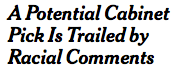
screenshot-2016-11-17-12-01-28

The poor guy is being trailed by those nasty racial comments. Maybe he can get a restraining order against them!

If you’re not actually burning crosses you’re not a real racist, just as anyone who isn’t Hitler can’t really be an antisemite. (And anyone who recalls the fake-Hitler-diary furore may also recall the breathless coverage that noted the absence of any reference to the holocaust, eager to absolve the Führer of the worst crimes.)

I think often of this exchange from the second presidential debate in 2000:

GORE: …The governor opposed a measure put forward by Democrats in the legislature to expand the number of children that would be covered. And instead directed the money toward a tax cut, a significant part of which went to wealthy interests. He declared the need for a new tax cut for the oil companies in Texas an emergency need, and so the money was taken away from the CHIP program… I believe there are 1.4 million children in Texas who do not have health insurance. 600,000 of whom, and maybe some of those have since gotten it, but as of a year ago 600,000 of them were actually eligible for it but they couldn’t sign up for it because of the barriers that they had set up.

MODERATOR: Let’s let the governor respond to that. Are those numbers correct? Are his charges correct?

BUSH: If he’s trying to allege that I’m a hard-hearted person and I don’t care about children, he’s absolutely wrong.

The words don’t adequately communicate the smarmy expression of offence that Bush displayed. Gore accused him of taking insurance away from 600,000 children. Bush didn’t respond or explain, but simply contended that to mention this fact was to insult him, to call him a “hard-hearted person”.

Trump and the bicycle-riders

We now have Donald Trump’s final argument for his election, which basically amounts to saying that manly man Donald Trump will beat down the foreigners and Jews — George Soros, Janet Yellen, Lloyd Blankenfein — who are secretly pulling the strings behind the political establishment. (Speaking of Janet Yellen, I have to confess that I hadn’t noticed that the Federal Reserve had been led by elders of Zion Jews — three of them Republicans — for all but nine years since 1970.)

I think often of a public lecture that Yale history professor John Boswell gave in the 1980s with the title “Jews and Bicycle-riders”. The title came from a celebrated anti-Nazi joke of the 1930s: A Jew is pushed off his bicycle by a Brownshirt, who looms over him and screams “Who is responsible for Germany’s misfortunes?” “The Jews,” replies the trembling Jew, “and the bicycle riders.” “Why the bicycle riders?” asks the Nazi. And he replies: “Why the Jews?”

Boswell’s lecture was mainly about homosexuality, pointing out that prejudice against gay people had risen and fallen over the past two millennia, and tended to parallel the ups and downs of antisemitism, and to be promoted by the same people. The joke suggests that antisemitism is irrational and arbitrary, and has nothing really to do with the Jews; Boswell extends this to say that antisemitism and homophobia are both targets of convenience for what is really an anti-urban, anti-cosmopolitan agenda.

(The bicycle-riders in the joke are supposed to be an obviously ridiculous target of discrimination. Boswell might have been amused to know that in the febrile politics of the 21st century, bicycle-riders have also become a frequent target of right-wing abuse — for example, Colorado Republican who called Denver cycling initiatives “part of a greater strategy to rein in American cities under a United Nations treaty” and Rob Ford in Toronto: “What I compare bike lanes to is swimming with the sharks. Sooner or later you’re going to get bitten… The cyclists are a pain in the ass to the motorists.”)

Obviously part of the point was that the credibility of antisemitism was at a low point in the mid-1980s, while discrimination against sexual minorities was decidedly respectable. From the perspective of 2016 things look decidedly different. Homophobia us barely tolerated in polite circles, while antisemitism is ascendant. I’m sure I thought in 1985 that the downward trajectory of antisemitism was inevitable — it was so obviously irrational — while the rights of gay and lesbian people seemed to need fighting for. In retrospect, I see that no matter how marginalised they may be, both of them are always capable of recolonising the body politic when the right conditions return. Somehow this seems to me more obvious and intuitive with regard to homosexuality than with regard to Judaism; Boswell’s link helps to clarify the danger.

Birtherism: Is it doping or unfair wage competition?

Consipiracy theories tend to be long on motive, short on coherence. The Elders of Zion may be hard to pin down, but it’s not hard to understand what they stand to gain by manipulating international commerce and news media. But Birtherism — the theory, mostly associated with Donald Trump, that Barack Obama was not born in the US, hence is no more an American than Ted Cruz — has always struck me as particularly lacking in motivation. Why would the Democrats take the risk of putting their fates in the hands of a non-citizen who could be unmasked at any time?

One theory is that this is a kind of unfair competition, like doping in sport: The rule requiring the president to be a natural-born US citizen is not a way of ensuring proper loyalty, but rather a guard against unfair competition. Of course, the thinking goes, Americans have little chance in a political competition against the inherent advantages of a Kenyan usurper. (Women, similarly, famously have such a structural advantage in politics that all manner of laws and customs have been required to level the playing field. Trump has pointed out the uphill struggle he faces, running for president as a wealthy white male, but garnered remarkably little sympathy.)

Another theory is that Obama is just another illegal immigrant, undercutting American workers on wages. The presidency pays only $400,000 a year. You can’t expect a qualified American man to work for that. That’s why only Trump, with his original proposals for monetising the presidency (derived from post-Soviet and Latin American models — who says he’s insular!) can be the great white male presidential hope.

Jews gone Wilde

I just read The Picture of Dorian Gray, which I last read — not very attentively, I think — in high school, more than 30 years ago. (For the record, it seems to me now an inappropriate choice of reading for high school.) No question that it is a great novel, even if Wilde would have been well served by a more assiduous editor who pointed out just how many times his characters “flung themselves” onto sofas, divans, wicker arm chairs, and “a luxuriously cushioned couch”. (They occasionally “throw themselves” as well. I wonder whether Stephen Leacock had this example in mind in writing his famous line “Lord Ronald… flung himself from the room, flung himself upon his horse and rode madly off in all directions.”)

The thoroughgoing misogyny of the book was familiar, but I had forgotten, or not noticed, the antisemitism. Early in the book significant attention is devoted to the peripheral figure of the low-rent theatre impresario who employs Dorian’s first idol, the young actress Sibyl Vane. He is first described as

A hideous Jew, in the most amazing waistcoat I ever beheld in my life, was standing at the entrance, smoking a vile cigar. He had greasy ringlets, and an enormous diamond blazed in the centre of a soiled shirt.

He is almost never referred to by name. He is always “the Jew”, “the horrid Jew”, “the old Jew” (and there is constant reference to his gaudy “jewelled fingers”). He is ugly, mean, wheedling, slovenly, an “offensive brute”, and even his “extraordinary passion for Shakespeare” is played for laughs, with the Jew blaming “the Bard” for his five bankruptcies, seemingly a parody of the only way a money-grubbing Jew could relate to the sublimities of English culture.

The pianist at the theatre, at his “cracked piano”, is also described as a “young Hebrew”, for no apparent reason other than to intensify the sense of artistic degradation.

“Serving the purposes of the Israeli apartheid and colonial regime”

The American Jewish reggae singer Matisyahu has been expelled from a Spanish music festival, for refusing to issue a statement in support of a Palestinian state. Apparently such loyalty oaths are required of suspect persons, such as Jews. His silence, they said, serves “the purposes of the Israeli colonial and apartheid regime”.

This buttresses the view that BDS has a significant dollop of antisemitism in its ideological matrix, even if not every BDS supporter is antisemitic (and not everyone motivated partly by antisemitism is entirely or even consciously motivated by antisemitism).

This takes me back to 2007, when one UK academic union, the National Association of Teachers in Further and Higher Education (since melded into the University and Colleges Union (UCU)) couldn’t find any more relevant challenge to higher education in the UK than a boycott of Israeli academics who do not “publicly dissociate themselves” from Israeli “apartheid policies”.

I immediately recognised a problem: What is the appropriate form for expressing such dissociation? And how would we test whether the self-criticism was sincere, or merely careerist dissimulation. After all, we wouldn’t want crypto-Zionists sneaking in to British universities and scientific conferences, infecting them with the taint of racism and colonialism. Leaping into the breach, I composed a form to enable the aspiring good Israeli to have his anti-Zionist bona fides tested and confirmed by the proper authorities.

More Zionist anti-semitism

I commented recently on the good fit between classical antisemitism and Zionism, despite the efforts of some to associate necessarily antisemitism with anti-Zionism, perhaps on the basis of both having the prefix “anti”. I just came across another forceful testimony to this alignment, from a figure less notorious than Adolf Eichmann. In the book Churchill’s Empire (about the development of Winston Churchill’s attitudes toward the British Empire), Churchill is quoted on the subject of Zionism from a 1920 newspaper article:

He distinguished between praiseworthy “National Jews”, loyal to the countries in which they lived, and the “sinister confederacy” of “International Jews” whom he claimed were largely responsible for the Bolshevik revolution. In this analysis Zionism offered a “third sphere to the political conceptions of the Jewish race”, and Churchill predicted that, “if, as may well happen, there should be created in our own lifetime by the banks of the Jordan a Jewish State under the protection of the British Crown […] an event would have occurred in the history of the world which would, from every point of view, be beneficial, and would be especially in harmony with the truest interests of the British Empire.”