Scotland, England, and Europe

I have no clear opinion about the upcoming referendum on Scottish independence — on the one hand, as a citizen of another former English colony, I understand the emotional appeal of revolution. On the other hand, as a current resident of England I fear the ensuing chaos, and rationally I really don’t think the negative consequences will necessarily — or even primarily — be felt south of the border. Furthermore, a UK without Scotland will be more conservative (and Conservative) and more xenophobic and anti-Europe.

This last point does suggest, though, a convenient resolution to one of the sticking points of Scottish independence — membership of the EU. The current UK government claims that an independent Scotland would have to negotiate membership like any other new applicant, and so would certainly lose the opt-out from the Euro, and other benefits, if secession-fearing members like Spain don’t block Scottish membership altogether; the Scottish nationalists say they would be negotiating a change of terms from inside the EU. But the Conservatives — who would doubtless attain a majority in a Scotland-free Parliament — have promised a referendum on withdrawal from the EU in the near future. Perhaps these could be coupled, and Scotland could simply inherit the UK seat in the EU. It would save everyone a lot of strife.

But saying that, it makes me wonder about the outcome of the EU referendum. I’d always assumed that Scottish independence would guarantee the UK’s exit from the EU. But would politicians in London really be willing to see their counterparts in Edinburgh and Dublin making European policy, and themselves excluded? It seems hard to imagine.

David Cameron’s other operation

Headline in the Guardian:

David Cameron: I will not resign if Scotland votes for independence

It reminds me of the Monty Python sketch about hapless gangsters, the Piranha brothers:

they began to operate what they called ‘The Operation’. They would select a victim and then threaten to beat him up if he paid the so-called protection money. Four months later they started another operation which the called ‘The Other Operation’. In this racket they selected another victim and threatened not to beat him up if he didn’t pay them. One month later they hit upon ‘The Other Other Operation’. In this the victim was threatened that if he didn’t pay them, they would beat him up. This for the Piranha brothers was the turning point.

If Cameron really wants to preserve the union, he needs to switch to the other other operation, promising that he will resign if Scotland votes to stay in the UK.

Logical crisis in Parliament

One of my favourite logical paradoxes (What, doesn’t everyone have a favourite logical paradox?) is the Unexpected Hanging. I first read about it from Martin Gardner, but you can read a summary here. A recent article in the Oxford Times, about the career plans of a local MP, raised a corresponding problem in the political realm:

Conservative Tony Baldry MP has announced he will stand down at the next General Election.

In a statement Sir Tony said: “One of the consequences of now having five year fixed term Parliaments is that if I succeed in being re-elected at the forthcoming general election, given my age, most people will assume that Parliament will be my last.

“I think this creates a danger that I may be unable to be as effective as I would wish to be; and that the constituency will be distracted from more important issues by the need to choose my successor.”

We might summarise his argument as beginning with three axioms:

  1. It is irresponsible for a politician to stand for parliament if the strong expectation is that this would be his or her last term.
  2. There is a strong expectation that someone will not stand for parliament past age 70.
  3. Terms are now fixed at five years.

Consider, now, the position of a responsible politician, whom we will call Tony65, who who will be, shall we say, 65 years old at the next election. He could stand for parliament now, but he will be 70 at the next election (axiom 3), and so the strong expectation is that he will not stand at the next election (axiom 2). Hence, by axiom 1, and the fact that he is responsible, he should not stand in this election.

But now consider Tony’s younger colleague; call him Tony60, who will be 60 years old at the next election. If Tony60 is elected, he will be 65 at the following election. As a responsible politician, like Tony65, he will stand down at that age. Thus this would be his last term, so by axiom 1 he will not stand at this election either.

By the same reasoning, Tony55 will not stand, since we know that he won’t stand again when he is 60. And so, we can keep backing it up to Tony20, who also can’t stand, because he won’t stand again when he is 25. (18 is the minimum age for election to the House of Commons.) Thus, we have proved:

Theorem: No responsible politician can stand for election to the House of Commons.

This theorem does not apply, for obvious reasons, to the House of Lords, so there will still be space for responsible (if unelected) government.


Peaking at the headlines

I was somewhat nonplussed by this headline on the BBC web site today

Screenshot 2014-09-04 11.34.08

In the centuries-long march of British anti-semitism, was the maximum really reached two months ago, since when it has begun its inexorable decline? Clicking through to the article reveals that, no, there is no evidence of a decline. Instead,

A charity set up to protect Britain’s Jewish community has recorded its highest-ever monthly total of anti-semitic incidents.

The Community Security Trust (CST) said it was aware of 302 such events in July, compared to 59 in July 2013.

So, even more disturbing than the headline suggested. Peaks have two sides, and you don’t know when the peak was until you’ve passed it.

Helicopter parents avant la lettre

I’m always intrigued by the eternal present of “nowadays”: Trends that rise and rise like an Escher staircase. Just now I was coming to the end of Anna Karenina — which I had expected would be just Madame Bovary on the steppes, but it was vastly more — and found this passage:

“He assures me that our children are splendid, when I know how much that’s bad there is in them.”

“Arseny goes to extremes, I always say,” said his wife. “If you look for perfection, you will never be satisfied. And it’s true, as papa says,—that when we were brought up there was one extreme—we were kept in the basement, while our parents lived in the best rooms; now it’s just the other way—the parents are in the wash house, while the children are in the best rooms. Parents now are not expected to live at all, but to exist altogether for their children.”

“Well, what if they like it better?” Lvov said, with his beautiful smile, touching her hand. “Anyone who didn’t know you would think you were a stepmother, not a true mother… Well, come here, you perfect children,” Lvov said to the two handsome boys who came in…

The time when children knew their place, and parents could enjoy themselves, is just a generation past, and apparently it always was.

Metric overlap

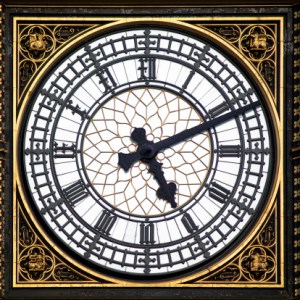
big ben faceI was just reading this article about the failure of the US to convert to the metric system in the 1970s — a review of the book Whatever Happened to the Metric System? by John Bemelmans Marciano. (About whose title I wonder, whatever happened to the phrase “what ever”? Isn’t “whatever” a completely different word? Whatever.)

It reminded me of my school days, when the units unit — the unit on converting between English and SI units — was a regular feature of every year’s math lessons. We were told that this would be important for the future, since everything was going to be converted to metric. Something to justify a lifetime of skepticism toward those

At the time, I thought it strange that so much time was being spent on converting between the old and the new units. Once you start using new units, you rarely need to convert to the old ones; and most of the conversion can be done with double-marked measuring utensils, like the measuring tapes that were then and still are ubiquitous. (I was fascinated when I first saw the 18th century clock faces that have the hours subdivided simultaneously into fours and into fives, the latter to accommodate the new-fangled minute hands, the former for the old one-handed system, where a single hand showed the time on a 12-hour or 24-hour scale (or 10-hour, if it was late 18th century Paris), with each hour subdivided into quarter hours. An example, from a much later date (mid-19th century, pictured above) is the face of Big Ben in London.

Emphasising conversions made it seem like metric requires hard math, as well as remembering things like 3.28 feet in a metre, or 454 grams in a pound, whereas it actually means you can stop remembering things like 5280 feet in a mile, or 4840 square feet in an acre, or 4 pecks in a bushel. But I remember being particularly struck at the time (the time being about 1980) by an argument I read, claiming that metric conversion would impose untold costs on the US economy, requiring the replacement of everything from shot glasses to wrenches. I found this claim very odd. Surely, I thought, the fact that we measure the size of drinks in millilitres rather than ounces doesn’t forbid us from making a drink have an odd number of millilitres, at least until the old glasses break.

It reminds me of when Deutsche Telekom, in the pre-competition days, proposed changing the basic unit of charging for local calls from three minutes to half a minute, or maybe it was even less. I remember listening to a call-in show on the radio where this was being discussed, and an elderly woman called to express her outrage. “Who would make a half-minute call? What can you discuss in so little time?”

Anyway, metric didn’t happen in the US, except for the 2-litre pop bottles, and gram bags of cocaine. But even where it did happen there remains an overlap of older units. In Britain, which has been metricated by law since EEC accession in the 1970s, house sizes are in square metres, petrol sold by the litre, and fruits are priced in pence per kilo, but beer is sold by the pint and distances between cities are generally measured in miles. People’s weights seem to be given equally in pounds, kilos, or stones (14 pounds). Commonly imperial units are given as alternatives to officially required metric units, suggesting that at least some portion of the public has a better intuitive grasp of the imperial units. But even in Germany, which had the metric system imposed by Napoleon more than 2 centuries ago, people still talk of “Ein Pfund Butter”, even if this “pound” of butter is a metricated pound, rounded to 500 grams.


“For he is an Englishman…”

For, in spite of all temptations

to belong to other nations

he remains an Englishman.”

Bringing together my posts from last year about cases of US citizens being expelled from or denied re-entry into their country, with my recent remarks on a senior UK politician’s suggestion that British citizens who fight with Islamists in Iraq and Syria have their citizenship revoked. This is of a piece with my earlier observations that xenophobic excesses which would be confined to the tub-thumping fringes in other countries, very quickly find resonance in the British political establishment, with the major parties falling over themselves not to be outflanked in expressing their hostility toward the alien.

To be fair, though, some moderately senior German politicians have made similar statements. The German constitution makes it absolutely explicit that citizenship cannot be revoked (except when a new citizenship is acquired, or when citizenship was acquired by fraud), which may make the belligerent exploitation of anti-Islamist chauvinism in these terms more or less despicable, depending on your perspective. (The US constitution is slightly less explicit, but reasonably clear on the subject.) By contrast, the UK — lacking both a written constitution and the clarifying experience of Nazi and Communist dictatorships — clearly makes revocation of citizenship a live option: 20 British dual nationals had their citizenship revoked last year, and the law — originally a 2006 Labour government product — was recently amended to allow the Home Secretary to deprive even single-nationals of their citizenship, rendering them stateless, showing blatant contempt for the 1961 UN Convention on Statelessness.

The only requirement for a naturalised British citizen — which includes many people born in the UK — to be deprived of his or her citizenship is that

the Secretary of State is satisfied that the deprivation is conducive to the public good.

Of course, “public good” is a pretty flexible concept, particularly when the Home Office is required to present neither an explanation nor evidence, and invariably takes the step when the individual is travelling outside the country, sending the notification to the home address in the UK (from which the person is known to be absent), allowing 28 days for appeal. Certainly the Nazi Home Secretary was satisfied that allowing Albert Einstein and Thomas Mann to return home would not be conducive to the public good. The GDR had the same trick of revoking citizenship when troublesome individuals were temporarily out of the country.

Lest anyone think the UK is recapitulating the march of tyranny, though, the Home Secretary has promised that this power will be used “sparingly”. That should be enough of a bulwark against fascism to satisfy anyone. And unlike the Nazi law on deprivation of citizenship, property is not confiscated, so it’s something completely different.

Creative destruction (Updated)

Headline on the NY Times website:

TV Chief Takes 2-by-4 to a Proposed Cable Merger

I was at first confused by the reference. Having grown up around my father’s lumberyard, I naturally think of a 2-by-4 as a basic element of house construction. For those whose experience of lumber is shaped by Mafia films, it’s an implement of destruction. (It’s interesting how the pop-culture image of organised crime has been shaped by the somewhat coincidental situation of the New York-New Jersey crime families who largely laundered their money through construction firms. Think “cement overshoes”.) I am reminded of the period in the early 1990s when skinhead mobs in Eastern Germany and Berlin suddenly started attacking foreigners, particularly but not exclusively asylum-seekers. The favoured weapons were baseball bats. I remember an article from around 1993, where a police expert was interviewed about why it was that baseball bats were ideally suited to be used as weapons, in addition to their advantage of having a legal use that endows carrying them with a superficial legitimacy, despite the fact that, as the German association of baseball enthusiasts admitted, the total number of baseball players in Germany was estimated at just a few hundred, substantially smaller than the number of baseball bats that had been sold in the past year. In any case, baseball bats (“Baseballschläger”) have become routine emblems of violence in German newspaper headlines, with no further explanation required, specifically xenophobic neo-Nazi violence. For example, when Der Spiegel reported on a government-sponsored youth music initiative with a CD of songs opposing neo-Nazi violence, the article was titled

Tonträger gegen Baseballschläger     (Recordings vs. Baseball Bats)

Interestingly, when Bill Gates handed over control of Microsoft to Steve Ballmer, Der Spiegel covered press reports with a headline “Baseball bat in his hand”, referring to an LA Times report that said

Ballmer, der dafür bekannt ist, dass er bei internen Besprechungen herumbrüllt und manchmal Anordnungen gibt, während er einen Baseballschläger in der Hand hält… (Ballmer, who is known for screaming during internal conferences, and sometimes holds a baseball bat in his hand while giving orders…)

It sounds much more menacing in German.

Update: Somehow I forgot the famous lyric from the gospel song Oh Mary Don’t you Weep (what I take to be Pete Seeger’s revised lyrics; at least, it’s clearly not part of the original spiritual, and does appear on Pete Seeger’s recordings, and later versions):

Moses stood on the Red Sea shore

Smotin’ the water with a two-by-four.

Pharaoh’s army got drowned.

Oh, Mary, don’t you weep!

Betrayal

After the nuclear bombing of Hiroshima and Nagasaki, many physicists felt that their discipline’s principles had been betrayed. Oppenheimer said that physicists had “known sin”. Their abstruse subject, seen as a pure source of enlightenment, had revealed its enormous destructive potential. The healing arts, the quintessence of noble pursuits, have also been showing their dark side, as the power to cure disease is inseparable from the power to cause disease. An Oath Betrayed was the title of a recent book on the role of U.S. physicians and psychologists in facilitating torture in Guantanamo. And now, yet another betrayal: The BBC reports that

The apparent killing of a US journalist by an Islamic militant with an English accent is "an utter betrayal of everything British people stand for", the foreign secretary says.

What of goodness and purity remains in the world, when even English accents may also be deployed for nefarious ends? (Of course, in Hollywood films they are used for almost nothing else.)

More profoundly, two thoughts occur to me: Continue reading “Betrayal”

Hiring formalities

One other point has occurred to me, with regard to the firing/not-quite-hiring of Steven Salaita at the University of Illinois, which I have commented on here and here. Defenders of the university’s decision say that he had no right to have his academic freedom respected by UI because he was not formally in their employ. The fact that he had accepted a written offer of employment nearly a year before, agreed on a starting date, signed a contract, quit his previous job, moved across the country, and been assigned courses to teach in the fall semester were simply free-time activities, which only would become a real employment in October — a month after he was supposed to start teaching — when the board that meets once a semester ratified the hiring.

Whether this is legally accurate I can’t really judge. But I’m just thinking about the effect on future hiring, particularly at UI, but elsewhere as well. Clearly no one is going to let themselves be fooled this way by UI in the future. Everyone knows that claims of “just a formality” are simply deception at that university, and will insist on ironclad promises before they begin steps to move to a position there. Other people will just spare themselves the stress by not applying for positions at UI. (Remember, this is not about low-level jobs, of which there is a great shortage in the humanities, and a huge mass of qualified people desperate to take any meagre job. This was a tenured position.) And the ripples from this decision will affect other universities as well. Even if they make the offer in good faith, why take the chance that someone will comb through your public utterances and scare the university off hiring you. Best to insist on an ironclad contract before taking any steps. And this includes withdrawing the applications from other posts. Universities are likely to find senior academics who they thought they’d hired suddenly withdrawing shortly before they were supposed to start, because they didn’t consider themselves bound by the agreement until the formalities were taken wrapped up, and in the interim they got a better offer. This is likely to gum up university hiring in the US for a long time to come. Procedures will have to change, and the traditional role of occasional board meetings to ratify hiring decisions changed or eliminated.