
The tyranny of the 95%

The president of the National Academy of Science is being quoted spouting dangerous nonsense. Well, maybe not so dangerous, but really nonsense.

I found this by way of Jonathan Chait, a generally insightful and well-informed political journalist, who weighed in recently on the political response to the IPCC report on climate change. US Republican Party big shot Paul Ryan, asked whether he believes that human activity has contributed to global warming, replied recently “I don’t know the answer to that question. I don’t think science does, either.” Chait rightly takes him to task for this ridiculous dodge (though he ignores the fact that Ryan was asked about his beliefs, so that his skepticism may reflect a commendable awareness of the cognitive theories of Stephen Stich, and his need to reflect upon the impossibility of speaking scientifically, or introspecting coherently, about the contents of beliefs), but the form of his criticism left me troubled:

In fact, science does know the answer. Climate scientists believe with a 95 percent level of certainty (the same level of certainty as their belief in the dangers of cigarette smoking) that human activity is contributing to climate change.

Tracking through his links, I found that he’d copied this comparison between climate change and the hazards of smoking pretty much verbatim from another blog, and that it ultimately derived from this “explanation” from the AP:

Some climate-change deniers have looked at 95 percent and scoffed. After all, most people wouldn’t get on a plane that had only a 95 percent certainty of landing safely, risk experts say.

But in science, 95 percent certainty is often considered the gold standard for certainty.

[…]

The president of the prestigious National Academy of Sciences, Ralph Cicerone, and more than a dozen other scientists contacted by the AP said the 95 percent certainty regarding climate change is most similar to the confidence scientists have in the decades’ worth of evidence that cigarettes are deadly.

Far be it from me to challenge the president of the National Academy of Sciences, particularly if it’s the “prestigious” National Academy of Sciences, or more than a dozen other scientists, but the technical term for this is “bollocks”. Continue reading “The tyranny of the 95%”
One-fifth of a teaspoon

I was brought up short by this odd sentence in a NY Times article on attempts to protect health-care workers treating Ebola patients:

At the peak of illness, an Ebola patient can have 10 billion viral particles in one-fifth of a teaspoon of blood. That compares with 50,000 to 100,000 particles in an untreated H.I.V. patient, and five million to 20 million in someone with untreated hepatitis C.

“One-fifth of a teaspoon” is an odd reference unit. I had to think a moment to realise that the reporter had presumably translated into American from Scientific the sentence

At the peak of illness, an Ebola patient can have 10 billion viral particles in one milliliter of blood.

As I discussed before, the partial conversion to the metric system has left fault lines between and within nations. And the attempt to cover over those cracks mechanically creates odd dissonances. Thus, the 19th century estimate of average human body temperature of 37 degrees Celsius (plus or minus about half a degree) gets turned into the incredibly precise sounding 98.6 degrees Fahrenheit. It makes as much sense as saying “28 grams of prevention are worth 454 grams of cure”.

If the reporter had thought about it, she might have translated less mechanically, writing “an Ebola patient can have 50 billion viral particles in a teaspoon of blood”. But that still leaves the weird resonance of “teaspoon of blood”. A millilitre can be water or blood or Martian atmosphere, but when I hear “teaspoon” I subliminally feel like it’s supposed to go in my tea, or cake, or soup. The thing that people like so much about these traditional units is their historical and narrative specificity, their attachment to human-scale measuring activities, but that also makes them awkward for transferring measurements between domains. I could state my height in furlongs, and my weight in grains, but I’ll just confuse people.

Before posting, I just wanted to check that I was right about the size of a teaspoon in milliliters. I asked Google, and received the information “1 Imperial teaspoon =5.91939047 millilitres”. So, first of all, I was surprised to learn — if indeed it is true — that the teaspoon has been standardised to the hundred-billionth of a litre. Second, I found the thought of “the imperial teaspoon” hilarious.

Can’t beat duct tape

I remember hearing a comedian — perhaps Garrison Keillor? — saying everything could be fixed with duct tape and WD40. “If it moves and it shouldn’t, duct tape it. If it doesn’t move and it should, use WD40.

I was reminded of this in reading today’s article in the NY Times about the Nebraska Biocontainment Patient Care Unit, a hospital unit specialised for treating the most contagious diseases, that has stood empty, with the staff conducting only drills, since its founding ten years ago, until the current Ebola outbreak. Ot the front line of the high-tech, state-of-the-art defence against contagion,

Nurses on the biocontainment team… take turns spending four straight hours in Mr. Mukpo’s room in full protective gear, including full face shields and three pairs of surgical gloves duct-taped to water-resistant surgical gowns.

For the last millimetre of sealing the boundary, you still can’t beat duct tape. I can’t see this making it into the advertising copy, though.

Political talk therapy

Two apparently unrelated items from Nick Clegg’s speech at the Liberal Democrats’ party congress: First the BBC quoted his exhortation to the party soldiers, that they should

go to the next election with their “heads held high”.

Then came his announcement of

the first national waiting time targets for people with mental health problems.

People with depression should begin “talking therapy” treatments within 18 weeks, from April.

Let’s see: If the depressed Liberal Democrats can get their talk therapy started in April, maybe they’ll hold their heads a bit higher by the 7 May election.

False positives, false confidence, and ebola

Designing a screening test is hard. You have a large population, almost all of whom do not have whichever condition you’re searching for. Thus, even with a tiny probability of error, most of the cases you pick up will be incorrect — false positives, in the jargon. So you try to set the bar reasonably high; but set it too high and you’ll miss most of the real cases — false negatives.

On the other hand, if you have a suspicion of the condition in a particular case, it’s much easier. You can set the threshold much lower without being swamped by false positives. What would be really dumb is to use the same threshold from the screening test to judge a case where there are individual grounds for suspicion. But that’s apparently what doctors in Spain did with the nurse who was infected with Ebola. From the Daily Beast:

When Teresa Romero Ramos, the Spanish nurse now afflicted with the deadly Ebola virus first felt feverish on September 30, she reportedly called her family doctor and told him she had been working with Ebola patients just like Thomas Eric Duncan who died today in Dallas. Her fever was low-grade, just 38 degrees Celsius (100 degrees Fahrenheit), far enough below the 38.6-degree Ebola red alert temperature to not cause alarm. Her doctor told her to take two aspirin, keep an eye on her fever and keep in touch.

She was caring for Ebola patients, she developed a fever, but they decided not to treat it like a possible case of Ebola because her fever was 0.6 degrees below the screening threshold for Ebola.

A failure of elementary statistical understanding, and who knows how many lives it will cost.

Absence of correlation does not imply absence of causation

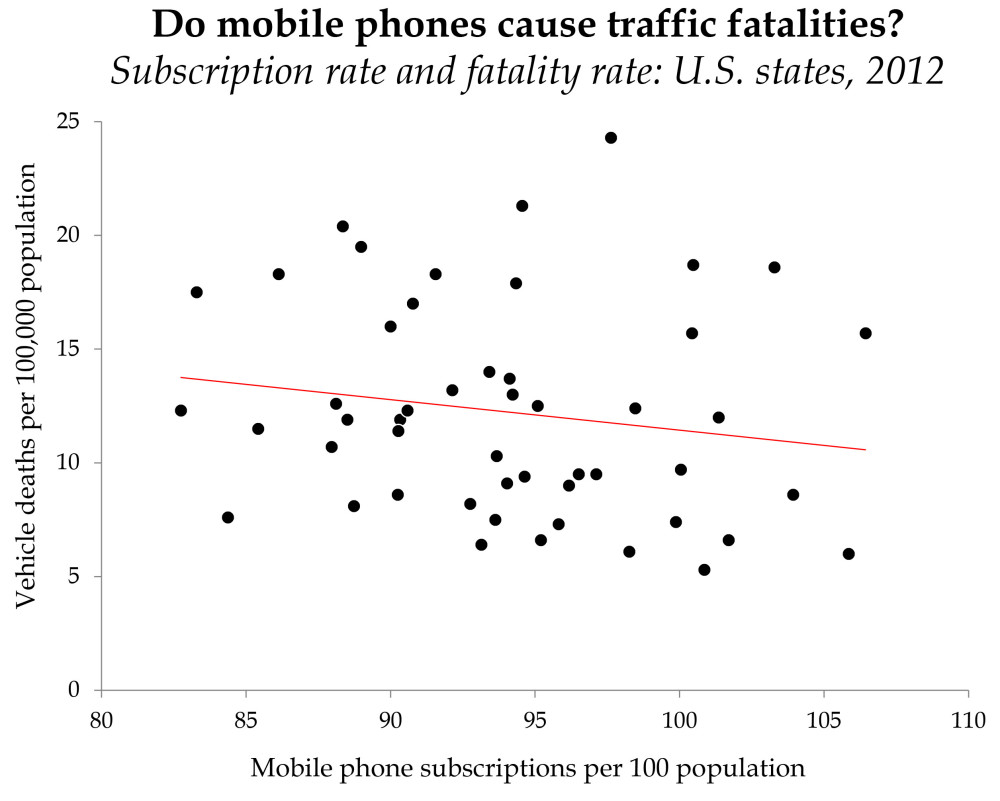
By way of Andrew Sullivan we have this attempt by Philip N. Cohen to apply statistics to answer the question: does texting while driving cause accidents? Or rather, he marshals data to ridicule the new book by Matt Richtel on a supposed epidemic of traffic fatalities, particularly among teens, caused by texting while driving. He has some good points about the complexity of the evidence, and a good general point that people like to fixate on some supposed problem with current cars or driving practices, to distract their attention from the fact that automobiles are inherently dangerous, so that the main thing that causes more fatalities is more driving. But then he has this weird scatterplot, that is supposed to be a visual knock-down argument:

We need about two phones per person to eliminate traffic fatalities...
We need about two phones per person to eliminate traffic fatalities…

So, basically no correlation between the number of of phone subscriptions in a state and the number of traffic fatalities. So, what does that prove? Pretty much nothing, I would say. It’s notable that there is really very little variation in the number of mobile phones among the states, and at the lowest level there’s still almost one per person. (Furthermore, I would guess that most of the adults with no mobile phone are poor, and likely don’t have an automobile either.) Once you have one mobile phone, there’s no reason to think that a second one will substantially

Whether X causes Y is a separate question from whether variation in X is linked to variation in Y. You’d like to think that a sociologist like Cohen would know this. A well-known example: No one would doubt that human intelligence is a product of the human brain (most directly). But variations in intelligence are uncorrelated with variations in brain size. (Which doesn’t rule out the possibility that more subtle measurements could find a physical correlate.) This is particularly true with causes that are saturated, as with the one phone per person level.

You might imagine a Cohen-like war-crimes investigator deciding that the victims were not killed by bullets, because we find no correlation between the number of bullets in a gun and the fate of the corresponding victim.

Just to be clear: I’m not claiming that evidence like this could never be relevant. But when you’re clearly in the saturation region, with a covariate that is only loosely connected to the factor in question, it’s obviously just misleading.

It’s a good thing they didn’t stop at 12…

The BBC reports today on the most recent THE global university rankings. The article is illustrated with a grinning, texting stock-photo student (I’m genuinely baffled as to what value these atmospheric photos are thought to add to news article) above the caption

The rankings rate universities worldwide on 13 measures, including teaching.

Wow! These rankings of higher education institutions were pretty thorough, if they even went so far as to include the quality of TEACHING among their 13 factors! If they’d had sufficient bandwidth for 14 factors they might have ranked them on the quality of their wine collections. Then Oxford would have come out tops for sure.

Devices like this one are sometimes still used to watch the BBC!

Frege and sexual abuse

Slate’s Amanda Hess has written about the case of Retaeh Parsons, a Nova Scotia girl who committed suicide last year, four years after being the victim of bullying over a photograph of her being sexually assaulted. She became famous across Canada after the police originally refused to prosecute those who assaulted her. The national, and then international, outcry, inspired some creativity among the reluctant police, who have now successfully prosecuted one of the perpetrators for child pornography.

The main point of the article was to comment on how

the judge in the case has barred Canadian journalists and everyday citizens from repeating the girl’s name in newspapers, on television, over the radio, and on social media. He cited a portion of Canadian criminal code that bans the publication of a child pornography victim’s name in connection to any legal proceeding connected to that alleged crime.

She quotes a Halifax reporter Ryan Van Horne on the perverse effect:

If you say the name “Rehtaeh” in Nova Scotia… you’ll be met with “instant recognition” of the case and all of the issues it represents. But when Van Horne asks locals, “You know that victim in that high-profile child pornography case?” he draws blanks. The famous circumstances surrounding Rehtaeh Parsons’ bullying and death don’t fit the traditional conception of a child pornography case, which makes linking the two difficult if reporters aren’t allowed to use her name and photograph.

This sounds like a horrible version of Frege’s Morning-Star/Evening-Star puzzle: News media (including social media) are allowed to talk about Retaeh Parsons (the famous child victim of sexual abuse and online harassment); and they are allowed to talk about the victim in that high-profile child pornography case. But they are barred from talking about Retaeh Parsons as the victim in that child pornography case. In Fregian terms, it’s as though we banned any reference to the “morning star”, but were still allowed to talk about the evening star.

Of course, there’s nothing terribly unusual here: Often important privacy concerns turn on concealing the identity of what appear to be two different individuals. It only seems so perverse here because the person whose privacy would implicitly be protected is 1) famous for her role in this case; and 2) deceased, which means that the only people whose privacy is being protected are the police officials who screwed up so badly in the first place.

Jews and evolution

Salon has published an interesting interview with former Commonwealth Chief Rabbi of the soi-disant Orthodox Jonathan Sacks about his new book about the relationship between science and religion. The man who did as much as anyone in recent years to break down cooperation and mutual respect between Orthodox and progressive streams of Judaism in the UK has rediscovered the virtues of mutual respect and toleration since stepping down last year from his post as Orthodox Chief Rabbi. At least, he believes strongly that atheists should respect him more.

One particular exchange caught my attention:

Why do so few Jews take issue with the theory of evolution, while creationism is common among Christians?

I think Christians tended to think that religion and science were part of the same universe of discourse. So they assumed that the Bible was telling us scientific stuff, as well as moral and spiritual stuff. Whereas Jews don’t read the Bible that way.

It surprises me that the good Rabbi feels so confident accepting the premise of the question, that Orthodox Jews are hip to modern (i.e., post-medieval) science. It’s hard to believe that he has become so disengaged from the cause of Jewish education in Britain in the past year that he failed to note the scandal earlier this year, when a Jewish girls’ school in London (state-funded, natch!) was found to be removing questions from A-level biology exams “because they do not fit in with their beliefs.”

Fifty-two papers were altered by Yesodey Hatorah Senior Girls’ School to remove questions on evolution.

This being Britain, where everything is a sport, no one cared much at first about the children being taught bogus biology; they only cared about the game being fair:

The examinations body, OCR, says it was satisfied that the girls did not have an unfair advantage. It now plans to allow the practice, saying it has come to an agreement with the school to protect the future integrity of the exams.

On more mature reflection, the exam regulator Ofqual did decide that excising questions from exams would be deemed “malpractice”.

Until I read of this controversy, I would have felt confident agreeing with Lord Sacks that there is no Jewish tradition for rejecting scientific biology. Now I’m obviously not so sure. Perhaps this represents part of the harmonic convergence between Orthodox Jewry and American Evangelical Christianity — rather like the way they’ve come to a consensus on supporting Israel, even if the motives may be discordant — Jews wanting Israel as a place to live, Christians wanting it as a place to stage Armageddon.

Define “senseless”

David Cameron has described the defection of Tory MP Mark Reckless to the anti-immigrant anti-Europe party UKIP not as “reckless” (too obvious), but as “senseless”. As in, absolutely nothing could be accomplished by this move to advance the anti-immigrant anti-Europe political agenda by this move.

In completely unrelated news, which BBC journalists unaccountably included in the same article, the prime minister announced that he would not argue in favour of staying in the EU in his planned 2017 referendum if he does not obtain concessions from the EU:

“If I don’t achieve that it will be for the British public to decide whether to stay in or get out,” he said.

But he added: “I have said this all my political life: if I thought that it wasn’t in Britain’s interest to be in the European Union, I wouldn’t argue for us to be in it.”

And Conservative Culture Secretary Sajid Javid told the Daily Mail the UK could still prosper if it chose to exit the EU. “I think it would open up opportunities. I am not afraid of that at all,” he added.