
Early greenhouse

I read a novel that I’d known about for a long time, but had never gotten around to: Ursula K. Le Guin’s The Lathe of Heaven. I was startled to discover that an essentially background point of the plot of this novel, published in 1971, was the destruction of the Earth’s environment by the greenhouse effect. This has already taken place before the events of the novel, set in the early twenty-first century.

Rain was an old Portland tradition, but the warmth — 70ºF on the second of March — was modern, a result of air pollution. Urban and industrial effluvia had not been controlled soon enough to reverse the cumulative trends already at work in the mid-twentieth century; it would take several centuries for the CO2 to clear out of the air, if it ever did. New York was going to be one of the larger casualties of the Greenhouse Effect, as the polar ice kept melting and the sea kept rising.

This is only incidental to the themes of the novel, which grapples with the structure of reality and the nature of dreams. But it amazed me to see global warming being confidently projected into our future, at a time when — as the climate-change skeptics never tire of pointing out — discussions of climate change tended to refer to the danger of a new Ice Age.

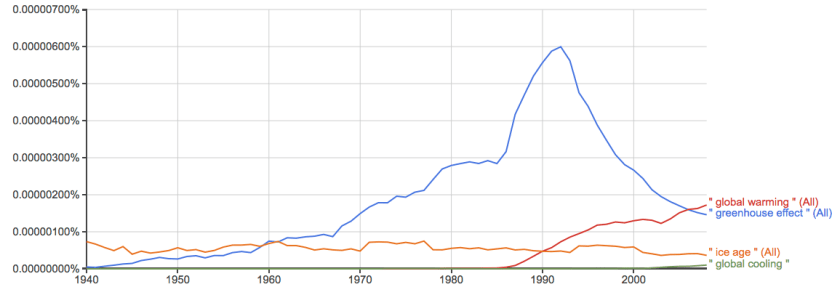
At least, that is my memory. According to the Google Books NGram viewer, though, the “greenhouse effect” was as mentioned in books around 1970 as frequently as it is today; and, oddly, it has declined substantially from a peak three times as high in the early 1990s.Screenshot 2015-12-16 14.22.01
For example, a 1966 book titled Living on Less begins its section on “The Environment” by discussing global warming, and launches right into a description of the greenhouse effect that sounds very similar to what you might read today.
Important punctuation

I had a student recently ask me to send a document that I’d promised a week ago. I sent it immediately, and then she apologised for badgering me about it. I replied

Not at all. My fault.

On reflection, it struck me as a powerful example of the importance of punctuation. It would have been a very different reply had I written

Not at all my fault.

Blurring the lines

Those of us of a statistical turn of mind and inclined toward caution (not the same, even if the categories may be highly correlated) like to compare the lives lost to terror attacks (about which there tends to be unbounded panic, leading to willingness to abandon vast stores of wealth, national pride, and long-cherished principles of justice) and to the sorts of banal lethal events that people don’t get very excited about. For example, there was the study showing that additional automobile travel due to fear of airplane hijacking in the few months following the 9/11 attacks killed more people — through the ordinary difference in automobile and airplane fatality rates — than were killed in the planes on 9/11 (and over time may have killed 2300 people, almost as many as the entire death toll of the attacks).

An obvious point of comparison is between the Paris terror attacks and the remarkably similar style of mass shootings that have become such a regular affair in the US. (More than one a day in 2015!) The latter evokes reactions ranging from a shrug to a right-to-bear-arms rally. The former have American conservatives — who not too long ago would eat nothing but freedom fries — expressing their fraternité with the noble liberty-loving French people, and the need to exclude refugees from ISIS from the US because you can never be too careful. The connection was best expressed by Texas congressman Tony Dale, with an “A” rating from the NRA, who argued that Syrian refugees need to be kept out of Texas because once legally admitted they would be entitled to Texas drivers licenses, and with those they could freely purchase firearms: Continue reading “Blurring the lines”

The right to be honoured

The journalist Barbara Ellen, writing in the Guardian, has defended Cambridge historian David Starkey, who has come under attack for his racist remarks:

An open letter to the university, signed by hundreds of staff, students and alumni, accuses Starkey of repeatedly making racist statements. It cites his appearance on BBC Newsnight after the summer riots of 2011 in which he said: “A substantial amount of the chavs have become black. The whites have become black; a particular sort of violent destructive, nihilistic gangster culture has become the fashion.”

It also cited a more recent interview in the Telegraph in which Starkey said statistics “appeared” to show a black propensity to violence.

A twofer: He insulted all black people, and simultaneously applied an insulting term for the white working class. Ellen protests

Free speech is one of the most precious facets of British society, but here is proof that, for some, it is all too dispensable. The pre-emptive ban is replacing the enriching debate. Nuance and difference are being hounded into the shadows.

How long before society reaches a state of self-monitoring, self-censoring “offence-Stasi”, with everyone on permanent red alert?

That sounds terrible. Starkey was “pre-emptively banned” merely for making perfectly ordinary disparaging remarks about black people. What was he banned from? Appearing as the leading spokesman for one of the world’s most esteemed universities in a promotional fund-raising video. That’s exactly the sort of thing that used to go on in communist police states. Continue reading “The right to be honoured”

Politicians debate statisticians and philosophers

I should have known the writing was on the wall for my career in Canada when, at the first federal election debate in 2006, the Bloc Québécois leader Gilles Duceppe said

We don’t need inspectors. We don’t need statisticians. We need doctors and nurses.

The rest of academia kept their heads down, hoping the storm would blow over. But now, not even a decade later, just south of the border, presidential candidates have another academic discipline in their sights. In yesterday’s Republican presidential debate Marco Rubio said

Welders make more money than philosophers. We need more welders and less philosophers.

As is pointed out here, the first statement isn’t actually true. Whether it should be true is another question. We might say, a philosophical question; although, in a serious dispute over the issue between a philosopher and a welder, I would not be surprised if the latter came out the better for it.

First they came for the statisticians…

Military fears emasculation, shrinkage

… but they’re not taking it lying down!

An anonymous “senior serving general” said in a recent interview that the army would “mutiny” if mere politicians tried to reduce the size of the military or take away its nuclear weapons (which are never called “weapons”, but rather “deterrent”, taking as self-evident that they would never be used.)

The unnamed general said members of the armed forces would begin directly and publicly challenging the labour leader if he tried to scrap Trident, pull out of Nato or announce “any plans to emasculate and shrink the size of the armed forces.”

He told the Sunday Times: “The Army just wouldn’t stand for it. The general staff would not allow a prime minister to jeopardise the security of this country and I think people would use whatever means possible, fair or foul to prevent that… and you would face the very real prospect of an event which would effectively be a mutiny.”

The head of the UK armed forces has repeated the threat publicly, if more obliquely.

Asked about Mr Corbyn’s refusal to use nuclear weapons, Sir Nicholas said: “It would worry me if that thought was translated into power as it were.”

So don’t think you can pansify the British Armed Forces into a girly, shriveled, no-nukes military just by voting for some new politicians!

Fat and spinach

There’s an old joke — I’ve seen it attributed to Clarence Darrow, but I have no confidence in this attribution — that goes

I don’t like spinach, and I’m glad I don’t, because if I liked it I’d eat it.

I thought of this in reflecting on the lessons of Nina Teicholz’s book Big Fat Surprise, about the sorry history of public health recommendations about dietary fat, mainly in the US. This will surely go down as one of the most embarrassing disasters in public health history, so Teicholz’s efforts to uncover how a supposedly self-correcting process was able to go so badly wrong holds important lessons for all of us who care about either science or public policy. (It’s sort of The Innocence Project, with observational studies in place of eyewitness misidentification.) Continue reading “Fat and spinach”

The Shabbat automobile (and other regulatory subterfuges)

It reminds me of the questions that folklorist Alan Dundes raised in his book The Shabbat Elevator and other Sabbath Subterfuges: Why do Orthodox Jews adopt enormously rigid strictures on every element of their lives, and then devote enormous energy and creativity to evading them, as when they tie a string around a whole neighbourhood to make an eruv, defined to be a single residence for purposes of the law that bans carrying objects in a public domain.

One could well ask, if a set of customs is deemed overly oppressive, why not simply repeal or ignore them?

At least they can argue that repeal isn’t really an option when you’re talking about divine law. But what about automobile pollution regulations?

Amid all the attention focused on Volkswagen’s bizarre cheating on diesel emissions tests — which ought to, but probably won’t, lead to multiple executives spending long terms in prison — some interesting lessons about the general nature of regulations and testing threaten to be submerged. As many have pointed out, real diesel emissions are many times higher than those permitted by regulations. The tests are routinely evaded, if not always as creatively as Volkswagen has done. Some examples: Continue reading “The Shabbat automobile (and other regulatory subterfuges)”

Condorcet method for choosing a religion

Making choices is hard! Particularly when there are multiple possibilities, differing in multiple dimensions. Like choosing the best religion.

There are many possible methods, leading to a variety of outcomes. The 18th century French mathematician Marie Jean Antoine Nicolas Caritat, the Marquis de Condorcet, advocated privileging methods of deciding elections that will always grant victory to a candidate who would win one-on-one against each other candidate individually. (Of course, there need not be such a candidate.) Such methods are referred to as “Condorcet methods”.

I’ve just been reading The Jews of Khazaria, about the seventh to tenth-century kingdom in central Asia that converted to Judaism around the middle of the ninth century.

According to the Reply of King Joseph to Hasdai ibn Shaprut, one of the few surviving contemporaneous texts to describe the internal workings of the Khazar kingdom,

Each of the three theological leaders tried to explain the benefits of his own system of belief to King Bulan. There were significant disagreements between the debaters, so Bulan went a step farther by asking the Christian and Muslim representatives which of the other two religions they believed to be superior. The Christian priest preferred Judaism over Islam, and likewise the Muslim mullah preferred Judaism over Christianity. Bulan therefore saw that Judaism was the root of the other two major monotheistic religions and adopted it for himself and his people.