
Without a net

One linguistic phenomenon that fascinates me more than it probably should is when a word or phrase can have opposite meanings in different contexts. Like the English word cleave (e.g. Genesis 2:24 “Therefore shall a man leave his father and his mother, and shall cleave unto his wife”, as opposed to a meat cleaver.)

I recently watched Ken Burns’s controversial 15-hour documentary Jazz. One segment, focusing on Miles Davis’s turn to fusion and electronica, was titled “Tennis Without a Net”. This quotes the critic Gerald Early, who appears in the segment, but of course refers back to Robert Frost’s bon mot about free verse (“tennis with the net down”). The implication is that music is a game, whose spectators are judging above all the players’ adroitness in accomplishing inherently simple things under complicated artificial constraints. Free jazz has also been tagged with this undead witticism.

So playing “without a net” means making things too easy, too safe, since no one can say if you’ve gotten it wrong. But “performing without a net” can also mean taking exceptional risks, as in the title of the Grateful Dead’s 1990 album “Without a Net”. There the metaphor is the circus acrobat’s net, and the implication is that the band’s free improvisation is particularly risky, since they are performing live without the support of a predetermined musical structure.

And this reminds me again of Natalia Cecire’s fascinating attack on statistics as an “inherently puerile discipline”, because its highest priority is “commitment to the rules of the game”. (I should make clear, as I argued before, I disagree with Cecire’s opinion of statistics, but I find the framework she lays on it both creative and useful.) Are statisticians making their research too safe by performing with the net of mathematical methodology, or are humanists like Cecire setting themselves a too-easy task by playing with the net of rigorous quantitative analysis down?

The Long Room: An academic allegory

Richard Tames’s A Traveller’s History of Oxford describes the “Long Room” of New College, a range of first-floor latrines built over a huge cesspit. Robert Plot, first superintendent of the Ashmolean Museum rhapsodised in the late 17th century that it was

stupendous… so large and deep that it has never been emptied since the foundation of the College, which was above three hundred years since, nor is it ever likely to want it.

The book also notes that this historical appraisal was in fact erroneous, as the pit had in fact, according to College records, been emptied in 1485.

The author does not make clear whether this description is intended as an allegory of academic productivity.

World’s Greatest Healthcare, ctd.

Addendum to my earlier post on US health care. Impressions from a friend’s trip, thankfully not an emergency in the end, to the emergency room of Children’s Hospital in Oakland:

  1. It’s not just the general practitioners in the US who are not very competent. So, a child being examined to exclude appendicitis is given a popsicle — presumably for hydration and glucose — by the intern. A bit later, he wants to give her IV fluids. Why can’t she just drink water? In case it is appendicitis, she shouldn’t take anything orally. Oh yes, I probably shouldn’t have given her that popsicle… I’m sure the microneurosurgeons in the US are first-rate, though. Continue reading “World’s Greatest Healthcare, ctd.”

Mutually Assured Logical Destruction

or, What Dr. Tortoise said to Prof. Achilles

I remember reading a biologist — I’ve forgotten who it was — remarking that, in comparison to some other fields, arguments in biology rarely turn venomous, because no matter how certain you may be, based on current knowledge, you can expect that within a few years the question will be definitively resolved one way or the other. If you are indeed correct, science will not suffer for your having indulgent your colleague’s error, and neither will your reputation. And you might be wrong. It’s very difficult to hold to absolute confidence in your own beliefs when they concern a matter of fact, and the fact will be revealed. It is a bit like the logic of keeping the peace through nuclear deterrence.

This was most trenchantly put by the great German mathematician David Hilbert, who famously commented on Galileo’s “cowardly” recantation in the face of the Inquisition:

He was not an idiot. Only an idiot could believe that scientific truth needs martyrdom — that may be necessary in religion, but scientific results prove themselves in time.

Continue reading “Mutually Assured Logical Destruction”

What’s the Matter with Economics?

One of the most politically important economics results of recent years has been the paper by Reinhart and Rogoff on the link between high sovereign debt and low GDP growth. This work is something I’d been following for a while, as R&R’s book was one that I’d admired greatly. Their work claimed to show a strong negative correlation between sovereign debt/GDP ratio and ensuing GDP growth, and was reported as saying that 90% debt/GDP ratio marks a cliff that an economy falls off, killing future growth. This was seized upon by proponents of austerity as proof that budget cuts can’t wait.

As reported here and here by Paul Krugman, and here and here by Matt Yglesias, it now turns out that the result isn’t just theoretically misguided, it’s bogus. Economists who struggled to reproduce the results finally isolated a whole raft of errors and dubious hidden assumptions that completely undermine the conclusion. Only the most blatantly ridiculous fault was an error in their Excel spreadsheet formula that caused them to exclude important sections of the data from their computation. You’d think that this couldn’t get any worse, but instead of apologising abjectly, R&R have tried to argue that none of this was really essential to their real point, whatever that was.

My main thoughts:

  1. Do economists really do their analysis with Excel? I find this kind of shocking, like if I found out that some surgeons like to make their incisions with flint knives, or if airline pilots were calculating their flightpaths with slide rules. Once you accept that premise, it’s not surprising that they made a blunder like this. I’m not a snob about technology. Spreadsheets are great for doing payrolls, and for getting a look at tables of numbers, and doing some quick calculations. But they’re so opaque, they’re not appropriate to academic work, and they’re so inflexible that it’s inconceivable to me that someone who analyses data on a more or less regular basis would choose to use them. Continue reading “What’s the Matter with Economics?”

The risk of terrorism

As an example of the irrational — or, at least, inconsistent — way our minds process risks with small likelihood, Andrew Sullivan has collected a few comments from around the web on the risk of being killed in a terror attack. When I am worrying about the risk of a bomb on a flight that I’m going on, I sometimes consider the following: There hasn’t been a bomb in a plane for a while. Suppose I knew that today someone had planted a bomb on a US commercial flight. Well, then I’d be thankful that I had been warned, and I’d have to be CRAZY to get on a plane that day.

But here’s the thing: there are nearly 30,000 commercial flights every day, so if I did take the flight, it would increase my risk of dying (assuming all onboard would be killed by the bomb, and ignoring other air-travel-associated risks, as well as the fact that being on the plane will protect me from other risks; I definitely won’t be hit by a bus while I’m flying) by about 0.0033%. Now, in a typical year a typical American has about a .039% chance of dying in an accident (ignoring other causes of death). So that insane decision to fly when you know there is a bomb on a plane somewhere in the US exposes you to about the same risk of dying a horrible sudden death as about a month of ordinary life. And if you knew only that there were a bomb on a flight somewhere in the world, the risk to you would be about the same as about 10 days of ordinary life.

Does this change the way we feel about the risk? Should it? It sort of works for me, but then, my fear was never very great, and my faith in numbers is exceptionally high…

Total Impact: Wakefield edition

So it seems Andrew Wakefield is back in the news. As Phil Plait has described well, the man who has done more to undermine public health than any physician since Martini and Rodenwaldt has been given space in The Independent to accuse the British government of inadequate measles prevention. Because his rantings scared lots of parents off the MMR vaccine, and the NHS didn’t want to provide separate measles vaccines instead.

The pathological self-promoters you will have with you always, so there’s no real surprise there. But it got me to thinking about his future in British medical research. Because some denizens of less enlightened lands may not know how IMPACTFUL British research has become: The prime directive for state-sponsored research under the current government (though I think it started already under Labour) is “impact”, defined as

an effect on, change or benefit to the economy, society, culture, public policy or services, health, the environment or quality of life, beyond academia

because academia is just a province of Faerie, not an actual part of the society or economy. In addition to impact being a crucial part of every grant proposal, and the postmortem on every grant after it’s completed, this definition will guide 20% of the scoring on the Research Excellence Framework (REF) just now getting underway, replacing the Research Assessment Exercise (RAE) last conducted six years ago, because now instead of research being assessed, we agree that it’s all excellent but needs to be frameworked, or something.

So anyway, it’s noteworthy that BENEFIT is only one acceptable form of impact. Any change or effect gets you points for impact, rather in the way the bibliometric citation counting that prevails in many academic fields doesn’t distinguish between citations for your paper providing key insights that inspired follow-on research, and citations that point out yet another bone-headed mistake in the paper that has been confusing researchers and holding back the progress of the field.

What’s more, it’s not clear how anyone would evaluate whether those who benefit from the research are themselves providing a net benefit or harm to society. (Sorry, I mean, to the taxpayer. There’s no such thing as society.) Presumably no one will provide a support letter from bioterrorists, explaining how their headline-generating work would have been impossible without the groundbreaking research of Professor X, but someone like David Li could show evidence that his work formed the industry-wide basis for the multi-billion pound market in mortgage backed securities which (you may have heard) helped to crash the world economy. The fact that he might himself agree that his formula never should have been applied, that the bankers “misinterpreted and misused it“, and that “Very few people understand the essence of the model“, doesn’t detract from the benefit that derived to some people, at least in the short term, and even the worst recession in 75 years certainly counts as a “change in the economy”, demonstrating the IMPACT of the research.

With that in mind, I reveal the hitherto secret Wakefield Impact Case Study, titled “Royal Free Hospital School of Medicine characterisation of risk factors for Autism and Vaccination Policy”. We are confident that the massively impactful Wakefield will quickly be hired by a major research institution and showered with research grants. Continue reading “Total Impact: Wakefield edition”

The educational value of Nazi propaganda

Being in Berkeley right now, I think often about Mario Savio’s famous speech, now approaching its 50th anniversary. This passage, in particular, came to my mind in regard to recent events:

Well I ask you to consider — if this is a firm, and if the Board of Regents are the Board of Directors, and if President Kerr in fact is the manager, then I tell you something — the faculty are a bunch of employees and we’re the raw material! But we’re a bunch of raw materials that don’t mean to be —  have any process upon us. Don’t mean to be made into any product! Don’t mean — Don’t mean to end up being bought by some clients of the University, be they the government, be they industry, be they organized labor, be they anyone! We’re human beings!

The news report that brought this to mind was the administrative punishment of an Albany NY teacher who assigned students to write an essay based on their reading of Nazi propaganda, in the voice of an aspirant to Nazi party membership trying to convince a superior that he understands why the “Jews are evil and the source of our problems”. I turns out that some pupils found this assignment unsettling, and unsettling the raw material impairs the quality of the marketable product. Continue reading “The educational value of Nazi propaganda”

Geodesic finance

chicago_ny newcable

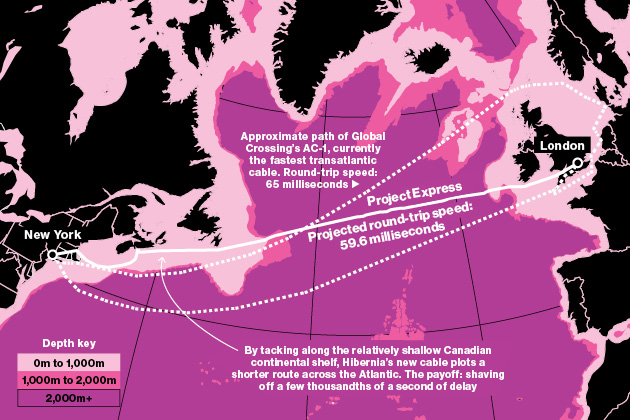
When I’ve written about the pernicious influence of high-tech finance, I’ve tended to emphasise the brain-drain and the flim-flam (the destructive influence on capital that gets drained into the pockets of the quants, and the embarrassing perversion of research priorities in mathematical sciences). But capital flows have no effect until they are realised in real-world allocation of resources. This is why I’ve been so dismayed by recent reports on investments being made in new fiber-optic lines connecting New York with Chicago and London. According to Businessweek private firm is spending $300 million to lay a transatlantic cable that is slightly shorter than the existing line, allowing round-trip transmission times to be reduced from 65 milliseconds to 59.6 milliseconds. And Forbes reported a few years back that another company was spending $300 million to reduce the New York-Chicago latency from 16 to 13 milliseconds.

What’s the point? Well, it’s pretty obvious that getting information quicker enables you to profit. Mark Twain was writing about this more than a century ago: In “Cecil Rhodes and the Shark“, where a young Cecil Rhodes makes his first fortune speculating in wool, based on foreknowledge of the Franco-Prussian war, gleaned from a newspaper found in the belly of a shark in Sydney, 50 days ahead of any ship-bound news reports from Europe. Continue reading “Geodesic finance”