Bake sales of the rich and famous

Via Rachel Larimore is this NY Post article about the struggle by headmasters of exclusive NY private schools to get wealthy parents to perform menial duties in person. Instead, many are sending nannies to

fund-raisers, designing sets for school plays and taking seats at graduations and public performances.

“Now the schools are getting angry — and other parents are getting angry. They don’t want to work the school bake sale with someone’s paid employee,” Uhry said.

Now, it certainly makes sense that the parents should be present in person to see the performances, and designing sets is at least a reasonable parent-child joint activity, though, as Larimore points out, it’s not clear why the schools aren’t hiring professionals to help children with these tasks. This seems to reflect, more than anything the schools’ lack of respect for crafts as educational activity: Presumably they don’t expect the parents to come in the afternoon to grade the math homework.

But bake sales? Why are schools with $40,000 a year tuition holding bake sales? What is the economic rationale for parents to pay a nanny $15 an hour (just guessing…) to sell cookies at 3 for $1 to raise money for the school? Surely the fundraising purpose would be better served by eliminating the middleman.

I appreciate that working together on a fundraising activity may be a bonding experience for parents (or children), but then again, it may not. Presumably for most non-impoverished parents — and that describes, I’m guessing, pretty much all parents at the schools in question here — the hours that the bake sale costs would be more valuable than the pittance that the activity brings in. If the parents wanted to devote that time to the school, there are probably more constructive contributions they could make.

Unless, that is, the bake sales of these schools are more lavish (and lucrative) than I can imagine…

How much do BART police earn?

I have great affection for BART (Bay Area Rapid Transit, to the uninitiated), and I have no criticism to make of the BART police. That said, I was somewhat astonished a few months ago when I saw an advertisement for BART police recruits much like the one below, except that it quoted numbers well over $100,000 for the salary range. I think they deserve to be well paid. They have a difficult and dangerous job, and they spend so much of their lives down in gloomy subway tunnels that (to judge by the evidence of the photo below) they are left blinking in stunned amazement when they are summoned up into the light of day to be photographed, and all but one seem to have had their growth stunted.

Obviously I wasn’t the only one who was surprised. They have now put up exactly the same poster, but with numbers barely half as big, and now supplemented with the word base in bold-face type modifying “annual base, entry-level pay range”. Boldfaced type really stands out in this context. Particularly with the comma after it. That line looks like the typographic incarnation of embarrassment.

BART police (cropped)

Not going anywhere

Is it a good thing to be “not going anywhere”? I thought about this when I read President Obama’s comment that “Planned Parenthood is not going anywhere”. As with many things in life, it depends on what the alternative is. It could mean “not going someplace good”. In Obama’s phrase, where it’s not going is presumably “away”, or into the dustbin of history. Or going downhill.

It’s another example of a self-negation, an expression that can mean two exact opposites. If Planned Parenthood is “going downhill”, we mean the future looks bleak. If it’s “all downhill from here for PP”, the future looks pretty good. The difference in metaphorical emphasis between these two is subtle. In “going downhill” we emphasise that up is good and down is bad, and don’t explicitly mention the relative difficulty of going up and down. In “all downhill from here” we think about the difficulty of going up relative to down, and ignore the question of whether it’s better to be up or down. The attention is focused on some sort of forward motion that presumably has been impeded by the uphill slog. So if PP isn’t going anywhere, it’s not going downhill. If it is going somewhere, it’s because it’s all downhill from here.

Bad apples

I remember being mystified back when President Bush defended his administrations stewardship of the Iraqi penal system by saying that the torture enhanced interrogation torture (I guess it was officially, since people got prosecuted for it) at Abu Ghraib was the work of “a few bad apples”. I guess that phrase had been going around for a while, and now it’s certainly common. (For example, here is the assertion that “a few bad apples” are responsible for most complaints about doctors.)

But back in 2003 I was confused by this expression. Bush seemed to be using it to mean that the US occupation of Iraq, and the US military and antiterror policies more generally, were sound, and that the crimes were the isolated work of individuals with no broader implications. But why apples? Why not “a few bad people”? The reference is clearly to the phrase “one rotten apple spoils the barrel”. But that expression has exactly the opposite implication: Rottenness is not isolated. If you’ve found “a few bad apples”, you must expect that the rot is widespread. Now, there’s nothing compulsory about that metaphor — you may not think that one bad individual casts suspicion on the rest — but why are apples being gratuitously referred to when the desired implication is exactly the opposite? How did this adage get turned into its converse? Or is the referent actually something else?

The risk of terrorism

As an example of the irrational — or, at least, inconsistent — way our minds process risks with small likelihood, Andrew Sullivan has collected a few comments from around the web on the risk of being killed in a terror attack. When I am worrying about the risk of a bomb on a flight that I’m going on, I sometimes consider the following: There hasn’t been a bomb in a plane for a while. Suppose I knew that today someone had planted a bomb on a US commercial flight. Well, then I’d be thankful that I had been warned, and I’d have to be CRAZY to get on a plane that day.

But here’s the thing: there are nearly 30,000 commercial flights every day, so if I did take the flight, it would increase my risk of dying (assuming all onboard would be killed by the bomb, and ignoring other air-travel-associated risks, as well as the fact that being on the plane will protect me from other risks; I definitely won’t be hit by a bus while I’m flying) by about 0.0033%. Now, in a typical year a typical American has about a .039% chance of dying in an accident (ignoring other causes of death). So that insane decision to fly when you know there is a bomb on a plane somewhere in the US exposes you to about the same risk of dying a horrible sudden death as about a month of ordinary life. And if you knew only that there were a bomb on a flight somewhere in the world, the risk to you would be about the same as about 10 days of ordinary life.

Does this change the way we feel about the risk? Should it? It sort of works for me, but then, my fear was never very great, and my faith in numbers is exceptionally high…

The educational value of Nazi propaganda

Being in Berkeley right now, I think often about Mario Savio’s famous speech, now approaching its 50th anniversary. This passage, in particular, came to my mind in regard to recent events:

Well I ask you to consider — if this is a firm, and if the Board of Regents are the Board of Directors, and if President Kerr in fact is the manager, then I tell you something — the faculty are a bunch of employees and we’re the raw material! But we’re a bunch of raw materials that don’t mean to be —  have any process upon us. Don’t mean to be made into any product! Don’t mean — Don’t mean to end up being bought by some clients of the University, be they the government, be they industry, be they organized labor, be they anyone! We’re human beings!

The news report that brought this to mind was the administrative punishment of an Albany NY teacher who assigned students to write an essay based on their reading of Nazi propaganda, in the voice of an aspirant to Nazi party membership trying to convince a superior that he understands why the “Jews are evil and the source of our problems”. I turns out that some pupils found this assignment unsettling, and unsettling the raw material impairs the quality of the marketable product. Continue reading “The educational value of Nazi propaganda”

Geodesic finance

chicago_ny newcable

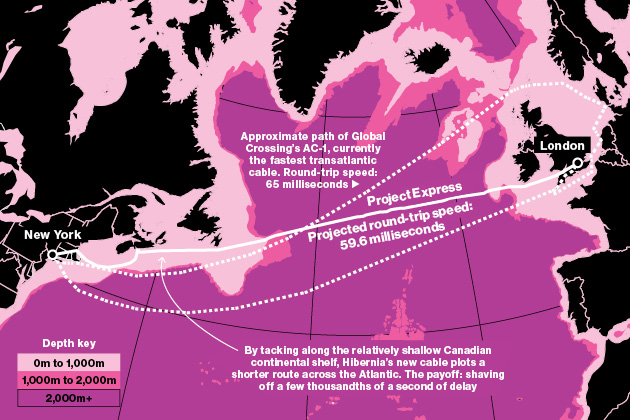
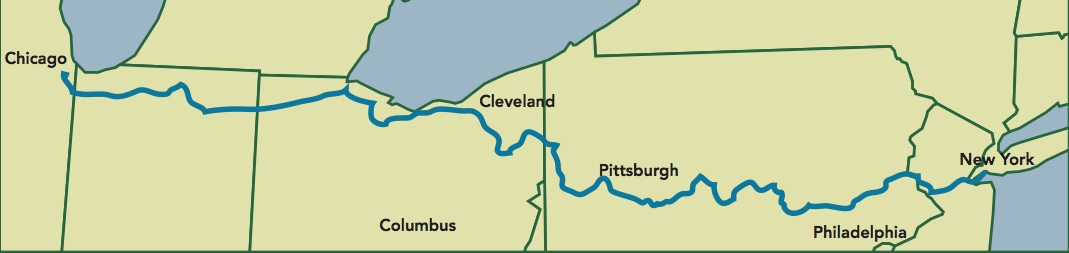
When I’ve written about the pernicious influence of high-tech finance, I’ve tended to emphasise the brain-drain and the flim-flam (the destructive influence on capital that gets drained into the pockets of the quants, and the embarrassing perversion of research priorities in mathematical sciences). But capital flows have no effect until they are realised in real-world allocation of resources. This is why I’ve been so dismayed by recent reports on investments being made in new fiber-optic lines connecting New York with Chicago and London. According to Businessweek private firm is spending $300 million to lay a transatlantic cable that is slightly shorter than the existing line, allowing round-trip transmission times to be reduced from 65 milliseconds to 59.6 milliseconds. And Forbes reported a few years back that another company was spending $300 million to reduce the New York-Chicago latency from 16 to 13 milliseconds.

What’s the point? Well, it’s pretty obvious that getting information quicker enables you to profit. Mark Twain was writing about this more than a century ago: In “Cecil Rhodes and the Shark“, where a young Cecil Rhodes makes his first fortune speculating in wool, based on foreknowledge of the Franco-Prussian war, gleaned from a newspaper found in the belly of a shark in Sydney, 50 days ahead of any ship-bound news reports from Europe. Continue reading “Geodesic finance”

Evasion and avoidance

Following up on my recent comments on piracy, recent news reports have forced me to learn the subtle difference between “tax evasion” and “tax avoidance”. Apparently “evasion” is when you don’t pay the taxes you’re required by law. “Avoidance” is when you don’t pay the taxes you’re required by law, but structure your property or income in such a way that you don’t pay (much) tax. It sounds like a pretty clear distinction, but the application can be dubious.

The Times recently reported on a widely used scheme that is so banal, so transparent, that one can hardly see it as representing anything other than a fig leaf to cover the authorities’ wish not to to tax the wealthy and powerful. The way it works is, extremely wealthy individual X doesn’t like his salary from company Y being taxed by government G, as though he were just an ordinary citizen. So he comes to an agreement with Y that they will stop paying him a salary, and instead pay an offshore shell company K2 for his services. So far so good. Y now pays no tax, because he has no income, but for obvious reasons this is not entirely satisfactory. Poor Y, who is now starving in a garret with no visible means of support, appeals to the good will of K2 (which has made such a great profit from Y’s tax aversion) for a loan. They’re a soft touch, and they loan him essentially all the money they’ve earned on his case, telling him, “Pay us back when you can.” He never pays it back, but they never lose hope. Loans are not taxable, of course, unless they are written off. Continue reading “Evasion and avoidance”

Boosting high finance

Some political commentators have suggested that the recent near-meltdown of JP Morgan Chase because of inability to cover its gambling debts might prove uncomfortable for Mitt Romney, who seeks the repeal of the Dodd-Frank law, that would likely have forbidden the gambles that the bank lost all the money with. How unimaginative! Surely, this is just one more example of how the Democrats, by attempting to rein in dangerous practices in the finance industry, are simply rewarding their Wall Street paymasters, while Romney is the lonely voice of equity (private), allowing the fat cats to suffer the consequences of their malfeasance.

I’ve been increasingly interested in the outsized role played by finance in the running of the modern world, and the role of mathematicians in intellectually laundering the financiers’ money. The most interesting (and chilling) book I’ve read in quite a while is Nicholas Shaxson’s Treasure Islands, a thorough investigation of the scope and method, nearly incomprehensible to outsiders, of tax havens and the global network of secrecy jurisdictions. Much of the otherwise impenetrable nature of British politics makes vastly more sense when one understands that the British Empire did not disappear, but was transformed into a network of shell countries centred on the City of London, whose vast financial power makes the paltry debates at Westminster nearly irrelevant (when the interests of the bankers and their clients are affected). Among the more minor but astonishing revelations is that the City of London — effectively, the representative of British finance on Earth — has its own representative in the House of Commons, the “City remembrancer”, a lobbyist for finance who is officially seated behind the Speaker’s chair (and has been since 1571). The City itself is exempt from many acts of Parliament and is outside the purview of the elected mayor of London, and its own self-government, the Corporation of the City of London, is selected almost entirely by the representatives of large banks.

And now the US seems on the verge of electing as president, not a Manchurian candidate, but a Caymans candidate, someone who is heart and soul part of of the international plutocracy, with his own funds stashed in the Cayman Islands and Switzerland. I am genuinely disturbed by this prospect.

My own comments on mathematical finance may be found here.