
False positives, false confidence, and ebola

Designing a screening test is hard. You have a large population, almost all of whom do not have whichever condition you’re searching for. Thus, even with a tiny probability of error, most of the cases you pick up will be incorrect — false positives, in the jargon. So you try to set the bar reasonably high; but set it too high and you’ll miss most of the real cases — false negatives.

On the other hand, if you have a suspicion of the condition in a particular case, it’s much easier. You can set the threshold much lower without being swamped by false positives. What would be really dumb is to use the same threshold from the screening test to judge a case where there are individual grounds for suspicion. But that’s apparently what doctors in Spain did with the nurse who was infected with Ebola. From the Daily Beast:

When Teresa Romero Ramos, the Spanish nurse now afflicted with the deadly Ebola virus first felt feverish on September 30, she reportedly called her family doctor and told him she had been working with Ebola patients just like Thomas Eric Duncan who died today in Dallas. Her fever was low-grade, just 38 degrees Celsius (100 degrees Fahrenheit), far enough below the 38.6-degree Ebola red alert temperature to not cause alarm. Her doctor told her to take two aspirin, keep an eye on her fever and keep in touch.

She was caring for Ebola patients, she developed a fever, but they decided not to treat it like a possible case of Ebola because her fever was 0.6 degrees below the screening threshold for Ebola.

A failure of elementary statistical understanding, and who knows how many lives it will cost.
Absence of correlation does not imply absence of causation

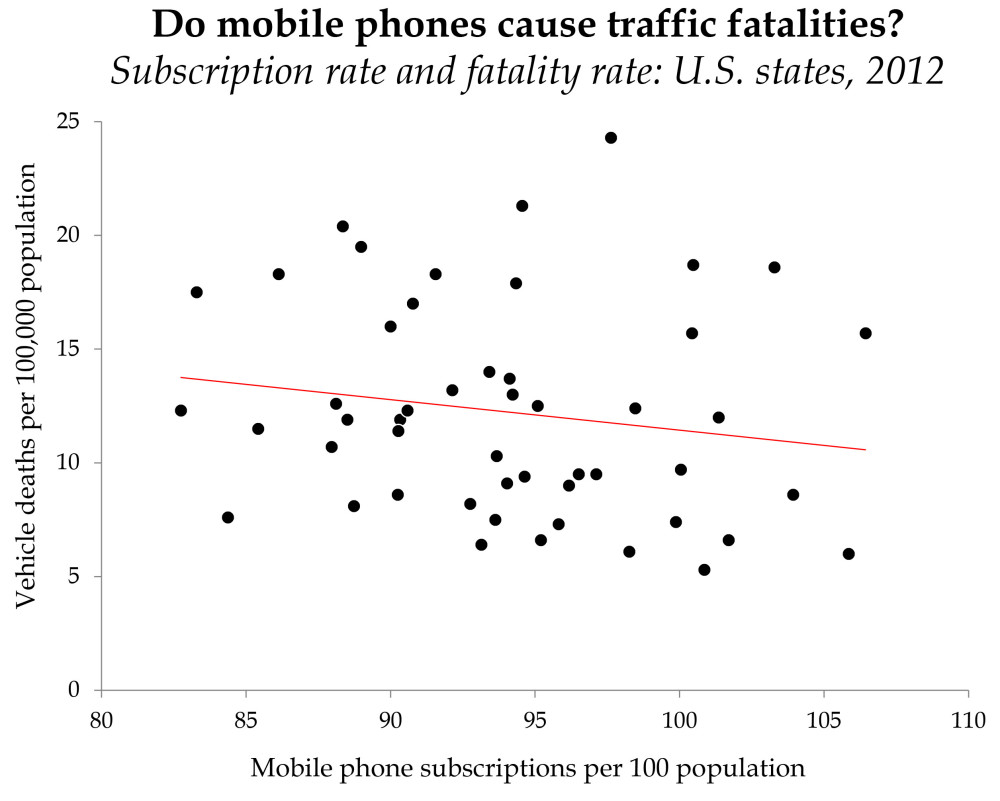
By way of Andrew Sullivan we have this attempt by Philip N. Cohen to apply statistics to answer the question: does texting while driving cause accidents? Or rather, he marshals data to ridicule the new book by Matt Richtel on a supposed epidemic of traffic fatalities, particularly among teens, caused by texting while driving. He has some good points about the complexity of the evidence, and a good general point that people like to fixate on some supposed problem with current cars or driving practices, to distract their attention from the fact that automobiles are inherently dangerous, so that the main thing that causes more fatalities is more driving. But then he has this weird scatterplot, that is supposed to be a visual knock-down argument:

We need about two phones per person to eliminate traffic fatalities...
We need about two phones per person to eliminate traffic fatalities…

So, basically no correlation between the number of of phone subscriptions in a state and the number of traffic fatalities. So, what does that prove? Pretty much nothing, I would say. It’s notable that there is really very little variation in the number of mobile phones among the states, and at the lowest level there’s still almost one per person. (Furthermore, I would guess that most of the adults with no mobile phone are poor, and likely don’t have an automobile either.) Once you have one mobile phone, there’s no reason to think that a second one will substantially

Whether X causes Y is a separate question from whether variation in X is linked to variation in Y. You’d like to think that a sociologist like Cohen would know this. A well-known example: No one would doubt that human intelligence is a product of the human brain (most directly). But variations in intelligence are uncorrelated with variations in brain size. (Which doesn’t rule out the possibility that more subtle measurements could find a physical correlate.) This is particularly true with causes that are saturated, as with the one phone per person level.

You might imagine a Cohen-like war-crimes investigator deciding that the victims were not killed by bullets, because we find no correlation between the number of bullets in a gun and the fate of the corresponding victim.

Just to be clear: I’m not claiming that evidence like this could never be relevant. But when you’re clearly in the saturation region, with a covariate that is only loosely connected to the factor in question, it’s obviously just misleading.

It’s a good thing they didn’t stop at 12…

The BBC reports today on the most recent THE global university rankings. The article is illustrated with a grinning, texting stock-photo student (I’m genuinely baffled as to what value these atmospheric photos are thought to add to news article) above the caption

The rankings rate universities worldwide on 13 measures, including teaching.

Wow! These rankings of higher education institutions were pretty thorough, if they even went so far as to include the quality of TEACHING among their 13 factors! If they’d had sufficient bandwidth for 14 factors they might have ranked them on the quality of their wine collections. Then Oxford would have come out tops for sure.

Devices like this one are sometimes still used to watch the BBC!

Frege and sexual abuse

Slate’s Amanda Hess has written about the case of Retaeh Parsons, a Nova Scotia girl who committed suicide last year, four years after being the victim of bullying over a photograph of her being sexually assaulted. She became famous across Canada after the police originally refused to prosecute those who assaulted her. The national, and then international, outcry, inspired some creativity among the reluctant police, who have now successfully prosecuted one of the perpetrators for child pornography.

The main point of the article was to comment on how

the judge in the case has barred Canadian journalists and everyday citizens from repeating the girl’s name in newspapers, on television, over the radio, and on social media. He cited a portion of Canadian criminal code that bans the publication of a child pornography victim’s name in connection to any legal proceeding connected to that alleged crime.

She quotes a Halifax reporter Ryan Van Horne on the perverse effect:

If you say the name “Rehtaeh” in Nova Scotia… you’ll be met with “instant recognition” of the case and all of the issues it represents. But when Van Horne asks locals, “You know that victim in that high-profile child pornography case?” he draws blanks. The famous circumstances surrounding Rehtaeh Parsons’ bullying and death don’t fit the traditional conception of a child pornography case, which makes linking the two difficult if reporters aren’t allowed to use her name and photograph.

This sounds like a horrible version of Frege’s Morning-Star/Evening-Star puzzle: News media (including social media) are allowed to talk about Retaeh Parsons (the famous child victim of sexual abuse and online harassment); and they are allowed to talk about the victim in that high-profile child pornography case. But they are barred from talking about Retaeh Parsons as the victim in that child pornography case. In Fregian terms, it’s as though we banned any reference to the “morning star”, but were still allowed to talk about the evening star.

Of course, there’s nothing terribly unusual here: Often important privacy concerns turn on concealing the identity of what appear to be two different individuals. It only seems so perverse here because the person whose privacy would implicitly be protected is 1) famous for her role in this case; and 2) deceased, which means that the only people whose privacy is being protected are the police officials who screwed up so badly in the first place.

Jews and evolution

Salon has published an interesting interview with former Commonwealth Chief Rabbi of the soi-disant Orthodox Jonathan Sacks about his new book about the relationship between science and religion. The man who did as much as anyone in recent years to break down cooperation and mutual respect between Orthodox and progressive streams of Judaism in the UK has rediscovered the virtues of mutual respect and toleration since stepping down last year from his post as Orthodox Chief Rabbi. At least, he believes strongly that atheists should respect him more.

One particular exchange caught my attention:

Why do so few Jews take issue with the theory of evolution, while creationism is common among Christians?

I think Christians tended to think that religion and science were part of the same universe of discourse. So they assumed that the Bible was telling us scientific stuff, as well as moral and spiritual stuff. Whereas Jews don’t read the Bible that way.

It surprises me that the good Rabbi feels so confident accepting the premise of the question, that Orthodox Jews are hip to modern (i.e., post-medieval) science. It’s hard to believe that he has become so disengaged from the cause of Jewish education in Britain in the past year that he failed to note the scandal earlier this year, when a Jewish girls’ school in London (state-funded, natch!) was found to be removing questions from A-level biology exams “because they do not fit in with their beliefs.”

Fifty-two papers were altered by Yesodey Hatorah Senior Girls’ School to remove questions on evolution.

This being Britain, where everything is a sport, no one cared much at first about the children being taught bogus biology; they only cared about the game being fair:

The examinations body, OCR, says it was satisfied that the girls did not have an unfair advantage. It now plans to allow the practice, saying it has come to an agreement with the school to protect the future integrity of the exams.

On more mature reflection, the exam regulator Ofqual did decide that excising questions from exams would be deemed “malpractice”.

Until I read of this controversy, I would have felt confident agreeing with Lord Sacks that there is no Jewish tradition for rejecting scientific biology. Now I’m obviously not so sure. Perhaps this represents part of the harmonic convergence between Orthodox Jewry and American Evangelical Christianity — rather like the way they’ve come to a consensus on supporting Israel, even if the motives may be discordant — Jews wanting Israel as a place to live, Christians wanting it as a place to stage Armageddon.

The sense of place

I read with amazement the new book My Promised Land: The Triumph and Tragedy of Israel by Haaretz journalist Ari Shavit.  For a book that is so attentive to the physicality of the land, and the particularity of place, it struck me as surprisingly willing to use place names in their platitudinous sense, in a context that made them leap off the page in bizarre ways:

By his very presence, he turns En Harod into the Mecca of the kibbutz movement.

… has turned a huge garage in southern Tel Aviv into the new mecca of dance, drugs, and casual encounters.

After seven and a half years in inferior and mediocre Sephardic institutions, Aryeh Machluf Deri had reached the Eton of the Ashkenazi ultra-Orthodox world.

If the thought of the Mecca of “dance, drugs, and casual encounters” doesn’t make your head spin (imagine, conversely, describing the Kaaba as “the Reeperbahn of pilgrimage and divine ecstasy”) then surely the thought of an ultra-Orthodox Eton must.

In all seriousness, the book accomplishes something I would have thought impossible: It tells the story of Israel from a Zionist perspective, while refusing to look away from, dismiss, or otherwise morally diminish the suffering inflicted upon the Arab population of Palestine. Ultimately, it’s the most depressing book on the subject I have ever read, not because of the horror that is recounted, but because holding up the justice and injustice of both sides to the cold light leaves the reader (and the author) with the sense that this is a paradox of justice that has no resolution, a doom of eternal conflict. Other books, like Max Blumenthal’s Goliath, that take a much harsher tone toward Israel and its political establishment, arouse a sense of moral fervour, a sense that just a bit of generosity and good will could bring both sides to the promised land of peace. Shavit’s is the disillusion of an old man, who has seen the rise and fall of grand hopes, and sees the avoidance of destruction as the best that his country can hope for.

Low unemployment rates for math/stat PhDs

I was interested to read of a recent NSF study, that found only 2.1% unemployment in the US for people with doctoral degrees in science, engineering, and health fields. That’s only about 1/3 the rate in the general population over age 25. But I found even more striking that within that group, those with doctorates in mathematics and statistics had lower unemployment than those in any other field, at 1.2%.

The Return of the Ampelmännchen

I’m in Berlin now, for the first time in ten years. I lived here for much of the 1990s, and much has changed since then. But the change that I found most striking is in the Ampelmännchen, the anthropomorphic red and green traffic signals that tell you to walk or not walk. When I was first in Berlin, the backlash against Western triumphalism was just starting. With the unification of Germany, all kinds of things that had been standardised within each of the former countries now needed to be standardised between them. In principle, this would have involved some sort of consultation and compromise between the two sides. In practice, the East was treated like a colony, and the western standards were simply imposed. (I wrote a long essay at the time about my perceptions of the resentment in East Berlin.)

The resistance converged on the Ampelmännchen. The East had sort of jaunty 1950s-era conspicuously male figures, while the West had sleek, modern, gender-neutral figures. They looked like this:

berlinwalksignals

By the time I arrived, quite a few signals had already been changed in East Berlin, and the Rettet die Ampelmännchen campaign (“Save the  Ampelmännchen“) was fighting to stop the losses. They distributed stickers with images of the Eastern Ampelmännchen, and hoped to slow their destruction. It was an inspired choice, since these Eastern Ampelmännchen are just so adorable. The arguments for the others — in particular, gender neutrality — may be convincing, but it is hard to contemplate their utter extinction without a pang.

Now, 20 years after the struggle broke out, I find that the Ost Ampelmännchen are everywhere in Berlin, even in the West. So, something has been saved. The rulers of the GDR vowed to create a Neuen Menschen (new man), but their only enduring success was the creation of a Neues Ampelmännchen.

Mixing up the issues

The Salaita fiasco rumbles along. I have commented before on the case, where the University of Illinois Urbana-Champaign took advantage of ambiguities in its hiring process to try to destroy the career of a tenured professor of American Indian Studies, whom they pretended to want to hire, and then fired after he had resigned his old job, but before his new contract had formally started. (Admittedly, by presenting it in these terms I’m pretending that it is not just a giant cock-up. This is what it looks like if you try to pretend that the people acting for the university have any idea what they’re doing. Depending on your perspective, I’m being either generous or unfair.) The current state of play is well summarised here. This was punishment for anti-Israel tweets that had attracted unpleasant attention of some of the university’s major donors.

Anyway, having made her university a place where senior academics need to consult with expert legal counsel before accepting a job offer — if they even want to challenge an international boycott and join an academic pariah — UIUC Chancellor Phyllis Wise (who insists, according to the Chicago Tribune, simultaneously that “she wished she had “been more consultative” before rescinding Salaita’s job offer, and said it could have led her to a different decision” and that “there was “no possibility” that he would work at the U. of I.”) has told the Chronicle of Higher Education that

“People are mixing up this individual personnel issue with the whole question of freedom of speech and academic freedom,” she said in an interview. “I stand by the fact that this institution and all of higher education stands on the bedrock of the importance of academic freedom and freedom of speech, and that we should be and are the place where we deal with the most contentious and difficult and complicated issues that face the world, and that we have to provide the platform where discussions that are difficult and contentious and uncomfortable and unimaginable happen.”

That’s the kind of careful thinking on challenging questions that we look to academic leadership for! Some confused people are mixing up the issues. UIUC stands foursquare behind the principles of academic freedom, and the open discussion of “difficult and contentious and uncomfortable” issues, while confronting the completely unrelated practical real-world challenges of firing a professor for openly making contentious and uncomfortable statements in a public forum.

Or, as the irrepressible Abraham Foxman, National Director of the Anti-Defamation League of B’nai Brith since before the Flood, more succinctly put it,

Donors give money and they expect certain things. There’s nothing wrong with them voicing their opinion.

Peaking at the headlines

I was somewhat nonplussed by this headline on the BBC web site today

Screenshot 2014-09-04 11.34.08

In the centuries-long march of British anti-semitism, was the maximum really reached two months ago, since when it has begun its inexorable decline? Clicking through to the article reveals that, no, there is no evidence of a decline. Instead,

A charity set up to protect Britain’s Jewish community has recorded its highest-ever monthly total of anti-semitic incidents.

The Community Security Trust (CST) said it was aware of 302 such events in July, compared to 59 in July 2013.

So, even more disturbing than the headline suggested. Peaks have two sides, and you don’t know when the peak was until you’ve passed it.
