Odium ex nihilo

The Guardian quotes actress Maureen Lipman saying that the recent attacks in Paris have her thinking of leaving London for the US, where you can be shot to death in a supermarket in an entirely nondiscriminatory and racially neutral way. (Israel was also on her list of destinations, because it is a place where Jews are famously safe from terrorist attacks.) But I was struck by this comment:

When the economy dries up, then they turn on the usual scapegoat: the usual suspect –the Jew. There is one school of thought that says it’s because of Israeli policies in the West Bank, it isn’t. There’s been antisemitism for the past 4,000 years.

It is common to link modern antisemitism to trends since the middle ages. Some say nothing has really changed since Tiberius. Some go back even to the Hellenistic period. Lipman almost doubles that history.

Some people have remarked on the weird persistence of antisemitism in places like Poland despite the absence of any significant numbers of remaining Jews. Lipman’s bracing theory is that antisemitism also pre-existed the Jews. As the prayerbook says, וְהוּא הָיָה וְהוּא הֹוֶה ,וְהוּא יִהְיֶה בְּתִפְאָרָה: It was, it is, and it ever will be.

Perhaps, just as some say that antisemitism maintained the Jews as a distinct people through the Middle Ages, pre-existing antisemitism actually called the Jewish people into existence. As Sartre famously said,

Loin que l’expérience engendre la notion de Juif, c’est celle-ci qui éclaire l’expérience au contraire ; si le Juif n’existait pas, l’antisémite l’inventerait.

The concept of the Jew does not arise from experience, but rather the Jew serves as a pretext to explain [the anti-Semite’s] experience. If the Jew did not exist, the anti-Semite would invent him.

Old-time Darwinism

I’ve just been reading Adam Tooze’s book on WWI and its aftermath. I see Tooze as the great Marxist historian that never was — I don’t know anything about him other than his two books, but I’m pretty sure he wouldn’t like the comparison — since the grandest human affairs, in his accounts, end up in orbit around the black hole of capital. Anyway, I came upon an interesting quote there that reminded me of why some people of good will found themselves repulsed by Darwinism, particularly by Darwinian hangers-on who try to cite the “lessons” of Darwinism for human affairs.

The Japanese delegation to the founding conference of the League of Nations sought to have a ban on racial discrimination written in to the League covenant. (Not that they opposed racial discrimination in general, but they often enough found themselves on the unpleasant end of it.) Colonel House, a senior American diplomat and advisor to President Wilson, suggested to British foreign minister Arthur Balfour splicing the line from the US Declaration of Independence “All men are created equal” into the Covenant preamble. Balfour rejected this out of hand.

The claim that all men were created equal, Balfour objected, “was an eighteenth-century proposition which he did not believe was true.” The Darwinian revolution of the nineteenth century had taught other lessons. It might be asserted that “in a certain sense… all men of a particular nation were created equal”. Bot to assert that “a man in Central Africa was created equal to a European” was, to Balfour, patent nonsense.

Of course, one needn’t look far to find scientifically-interested chatterers — and occasionally scientists themselves — citing Darwin-themed research to prove that all the prejudices they ever had (these days they tend to emphasise difference between sexes rather than between races) are not only true, but indisputable because they have been proved by science.

I suppose it’s also worth reminding oneself what kind of racist colonialist swamp early Zionism got its start in.

The great cartoon shortage

I just came across this report on a call by cartoonists (including the second-place finisher in the 2006 International Holocaust Cartoon Competition) for the Angoulême International Comics Festival to boycott ‘any Israeli entity that does not “promote freedom and justice for Palestinians.”’ I take the role of cartoonists in a free society very seriously, but I can’t help thinking that the attempt to force the Zionist oppressors to their knees with a cartoon boycott would be a great subject for a cartoon.

Clushtering

I was somewhat nonplussed by this article in Slate by journalist John Ore, who gives up drinking alcohol every January and had the dubious inventiveness to coin the name “Drynuary” which, he says, has caught on in some circles. What I found odd was that he seems to be plagued by demands to explain or hide the fact that he’s not drinking alcohol.

Everyone who knows me well already understands that I do this Drynuary madness every year—I’m not shy about it, after all—so their immediate reaction is usually an eye-rolling “Again?!” as they pathetically try to peer-pressure me into doing a shot with them.[…]

My wife, and other pregnant friends, have used certain sleight-of-hand tricks early in a pregnancy before they were ready to reveal that they were expecting. She would order the same drink as I would—say, a glass of red wine with dinner—and wait until mine was almost drained. Subtly, we’d switch glasses when no one was looking, and viola! It looked like she was pounding hers, and I was playing catch up.

It seemed odd to me personally because I rarely drink alcohol — and in Oxford that means frequently turning over my wine glass at dinners and drinking orange juice at social events with students — but I can’t recall that anyone has ever asked me why. Maybe it’s a difference between Britain and the US — more universal alcohol consumption here, but less eagerness to intrude on other people’s privacy — but I never had those questions when I lived in the US either. (Once I recall someone expressing surprise that I did drink something alcoholic, but without asking for an explanation. Perhaps I was just not sufficiently sensitive to the implications.)

I recently came upon this plot of alcohol consumption in the US. About 30% consume no alcohol, and the median is about one drink per week. So if Ore were hanging out with average Americans one would have to think that one in three of his companions would also not be drinking, and a second of three might very well pass on the opportunity as well. It wouldn’t seem worth commenting on. But obviously people don’t hang out with random samples of the population. And he specifically says that in his profession — presumably he means journalism — “business events and travel naturally involve expense accounts and the social lubricant of alcohol.” I’ll refrain from commenting on what this might explain about the state of journalism as a profession, but I’m pretty sure that in my profession alcohol definitely doesn’t get to be counted as a travel expense, and in some cases even the bottle of wine shared at a post-seminar dinner needs to be paid for separately because it’s specifically excluded. Continue reading “Clushtering”

What’s German for “lame stream media”?

Don’t take words out of my mouth! … or out of my protest sign!

Der Spiegel has posted a short video of a recent anti-Islam demonstration by PEGIDA, a German organisation whose name is an acronym for Patriotic Europeans Against the Islamisation of the West. In one brief segment, starting at about 1:35, a journalist speaks with a demonstrator who is carrying a sign with the message “Islam = Karzinom” (Islam = Carcinoma, i.e., cancer).

Reporter: I wonder if you could explain your sign to me, why you draw this equivalence between Islam and a carcinoma?

Demonstrator: I don’t say they are equivalent, as you’re trying to suggest.

R: But it says there “Islam equals Carcinoma”.

D: Exactly.

R: Well, then, explain to me what you mean by that.

D: I’m not giving you any more information.

You really need to watch it — even if you don’t understand the language — to appreciate the mixture of befuddlement and hostility in this smug old protester, who seems to think that expecting demonstrators to account for their over-the-top slogans is just one of those devious tricks typical of highbrow lefty journalists. (I don’t think there’s a German word for lame stream media.)

On not getting the joke

Last week, in Paris, along with sundry other victims, 8 cartoonists and journalists at Charlie Hebdo were killed for pushing the envelope of free speech and political humour. The French authorities have been expressing their own rollicking sense of political irony by jailing dozens of people for the offense of commenting favourably on that crime against freedom of epression. (There is a spanking new law prohibiting apologie publique d’actes de terrorisme (publicly defending acts of terrorism).)
For example, a man was sentenced to 10 months in prison for saying (to officials who were arresting him for riding a tram without a ticket) “Les frères Kouachi, c’est que le début, j’aurais dû être avec eux pour tuer plus de monde.” (“The Kouachi brothers, that’s just the beginning. I should have been with them to kill even more people.”)
Sounds like the sort of thing Charlie Hebdo would attack mercilessly.

Possibly highly likely

Apparently I’m not the only one who finds the government’s vocabulary for risk of terror threat confusing. MI5 has estimated the risk of international terrorist attack in the whole UK as “severe”, which sounds pretty threatening, hardly a calming prospect. And yet, according to yesterday’s Times

Sir Bernard Hogan-Howe, the Metropolitan police commissioner, called for calm in an interview with Sky News on Friday, saying: “I don’t think it’s likely but I think we all know it’s a possibility — the threat level is severe and so therefore that means a terrorist attack is possible.

I’d say that calling the threat level “severe” is not what you do when you want the public to be “calm”. But then, his description corresponds to the official designation “moderate”. Obviously, no one wants to be the one who lowered the threat level right ahead of an attack, whereas leaving the threat level up for a few extra months (or years) has only diffuse and impersonal costs. Except that then you have to go out telling people that they shouldn’t really panic, even though the government says a terrorist attack is highly likely.

On a somewhat related note, the MI5 website ought to win a prize for the least helpful infographic. To illustrate the different threat levels for Great Britain and Northern Ireland they give us this map:

MI5 threat level graphic
For those plotting an attack in Northern Ireland but who can’t remember where it is…

There are just two “regions” whose threat level needs to be communicated. Is it really helpful to paste them onto geographically detailed maps of the United Kingdom? I’m guessing that, while they don’t want to specify any particular regions as potential targets, they don’t specifically want to make the point that Portree is equally at risk to certain southern metropolises with names beginning with L.

A small majority

From SPIEGEL’s article about the Oxford PPE degree, where the rich and powerful met when they were only rich and young:

Tatsächlich kommt die Mehrzahl aller Oxford-Studenten von Privatschulen, die sich nur sehr wohlhabende Eltern leisten können: Obwohl nur sieben Prozent aller britischen Schüler auf Privatschulen gehen, machten sie 2013 in Oxford satte 44 Prozent der Studienanfänger aus.

Indeed, the majority of Oxford students come from private schools, that only very wealthy parents can afford: Although only seven percent of British children attend private schools, they were 44 percent of the matriculants at Oxford in 2013.

Even a government minister who studied PPE could tell that 44 percent isn’t a majority…

The article continues, quoting Danny Dorling, on Oxford Geographie-Professor in Oxford as saying

Vier Privatschulen und eine hochselektive staatliche Schule schicken mehr Studenten nach Oxford als die restlichen 2000 staatlichen zusammen genommen…

Four private schools and one highly selective state school send more students to Oxford as the remaining 2000 state schools put together…

I have to assume that this has been misquoted or mistranslated. There are not 2000 (or 2001) state secondary schools, but more than 3000. There are about 6600 undergraduates from state schools and 5200 from private schools. That would mean that at least 1400 undergraduates — about 400 a year — come from this one state school, and presumably a lot more.

My guess is, what he really said (or meant to say) is that these five schools send more students to Oxford than the bottom 2000 schools. Which doesn’t sound so strange, actually. The average number of Oxford places per school is less than one/year. In any given year most schools would send no one to Oxford. Even if schools were all equally good, if there are highly selective schools, they would be expected to send a large number of students to Oxford.

Up is down

I mentioned in an earlier post George Lakoff’s work on metaphorical language. One fascinating issue is the way same metaphorical target can be mapped onto by multiple conceptual domains, and sometimes these can come into conflict — or a metaphor can come into conflict with the literal meaning of the target. When the figurative-literal target conflict is particularly succinct, this tends to be called “oxymoron”. One of my favourites is the 1970s novel and subsequent film about a burning skyscraper, called The Towering Inferno.

This particular one depends on the conflict between the “UP is GOOD, DOWN is BAD” metaphor (an indirect  form of it, since it goes by way of DOWN is BAD is HELL is BURNING), conflicting with the literally towering skyscraper. Anyway, the UP-DOWN dichotomy gets used a lot, creating lots of potential confusion. For example, UP is DIFFICULT and DOWN is EASY, inspiring the famous allegory of Hesiod that inspired so many devotional images:

Vice is easy to have; you can take it by handfuls without effort. The road that way is smooth and starts here beside you, but between us and virtue, the immortals have put what will make us sweat. The road to virtue is long and steep uphill hard climbing at first.

Hence the uncertainty of the phrase “Everything’s going downhill.” Is it getting worse, or getting easier?

There is a triple ambiguity when numbers get involved. LARGE NUMBERS are UP (“higher numbers”, “low number”) when we are counting the floors of a building, but SMALL NUMBERS are UP when ranking (#1 is the winner and comes at the top of the list).

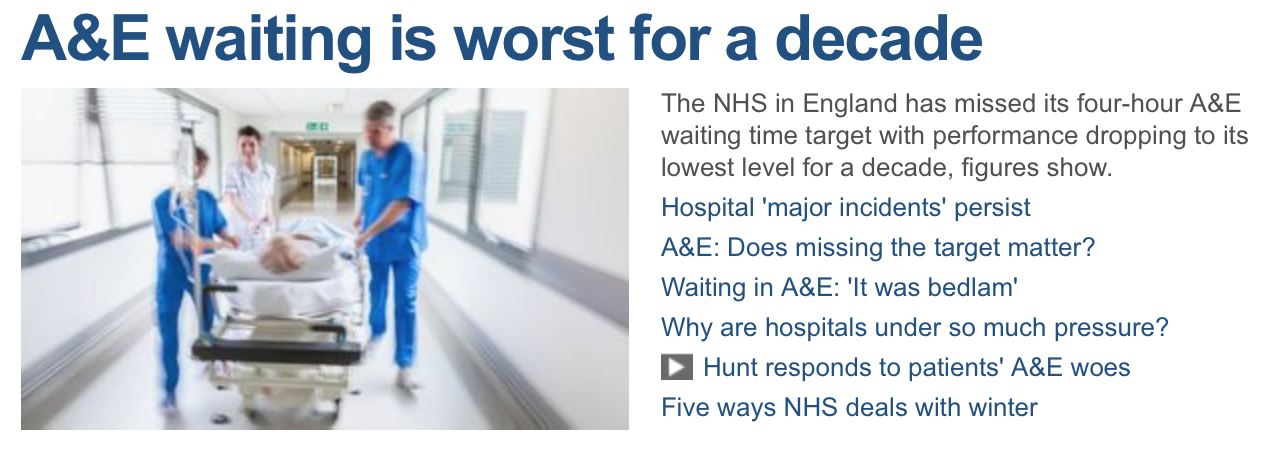
This brings us to the example that inspired this post. The BBC news web site this morning told us that “A&E waiting times in England have fallen to their worst level for a decade.” It’s hard to feel much sense of urgency about the fact that waiting times have “fallen”.

BBC website A&E morning


Presumably that’s why the text had changed in the afternoon:

bbc website afternoon

Aposematism and toy guns

Another person has been shot in the US because he was brandishing a toy gun.

Police hit the 32-year-old man three times Sunday evening after he pulled from his waistband what was later determined to be an air gun, which fire metallic projectiles such as pellets or BBs, police spokesman Albie Esparza said.[…]

The air gun did not have a colored tip on it, which is a standard identifier of a toy gun, Officer Gordon Shyy said Monday.

Actually, this wasn’t even exactly a “toy”. More, a sublethal weapon. I’m generally not the most sympathetic to police officers who kill the citizens they are supposed to be protecting. (In Utah last year police were the leading category of homicide perpetrators.) And the case of the boy who was shot on a playground because he had a toy gun clearly seems tinged with racism. But I can’t blame the problem on a lack of coloured tips on the gun.

Surely a brief thought about warning colours and mimicry in nature suggests that a strategy that says “a red tip means the police don’t need to worry about this otherwise very dangerous-looking weapon” can’t be viable. It’s too easy to mimic the signal and gain the advantage (lessened police response to your weapon). This is not quite the same as aposematism — advertising ones inedibility to predators through defensive colouration — but the general problem of cheap signals undermined by mimicry is the same. Continue reading “Aposematism and toy guns”