Why are bank accounts so complicated?

A BBC report today says that some popular current account packages are having their fees increased substantially.

The change in Santander fees – announced in September – will see customers paying £60 a year, instead of the previous fee of £24. The charge for its 123 credit card rises from £24 a year to £36.
Last year the Santander account proved very popular, with more than 27,000 people switching to it in a single month. But experts said that – even after the changes -it still offered relatively generous interest payments of up to 3% a year, and cashback of up to 3% on some household bills. “Don’t jump ship until you’ve done the maths,” said Hannah Maundrell, editor in chief of advice site Money.co.uk. “To put it simply, you need to look at how much you’re earning in interest and cashback. If it’s less than the new £60 a year fee you need to take it as a wake-up call to seriously consider your options.”

Why should people need to do complicated calculations to figure out whether their bank is scamming them? Obviously, this is a rhetorical question. I know, sort of, that banks see current customers as locked in, so they are motivated to provide a minimum of interest and service to them, while trying to dislodge a few customers from other banks with some flashy (but inexpensive) offer.

Barclays has said it will double its cash rewards programme for those who take out an account this month. Marks and Spencer is already offering incentives worth up to £220 to anyone who switches.

The article cites experts arguing about whether the banks have been forced to charge more because of increased costs, or whether they are padding their profits. But even have to raise the question shows how pathological banking has become. It’s the consumer

Every few years I find myself in my bank, needing to spend half an hour talking with a customer-service drone about why the Super Privilege Advantage account doesn’t pay interest anymore, but if I switch to the brand new Club Lloyds (really) Account I’ll get interest (varying amounts depending on my balance, increasing up to £5000, and then cutting out after that.

By the theory of the competitive market, you might think that someone would see an interest in providing simple financial services, to people who have better things to do than discuss their half a percent interest with a bored bank employee for half an hour every year or two.
Chinese towels

Another thought about Elizabeth Holmes and Theranos: Her billion-dollar medical-testing company based on secret and unproven technology in her twenties depended largely on a board of well-connected politicians and former politicians, notable for their lack of any relevant scientific expertise. But before she got to that point she needed to turn the heads of some scientists. According to the New Yorker, she caught the attention of dean of engineering Channing Robertson in her freshman year at Stanford:

One day, in her freshman year, Robertson said, she came to his office to ask if she could work in his lab with the Ph.D. students. He hesitated, but she persisted and he gave in. At the end of the spring term, she told him that she planned to spend the summer working at the Genome Institute, in Singapore. He warned her that prospective students had to speak Mandarin.

 “I’m fluent in Mandarin,” she said.

“I’m thinking, What’s next? She’s already coming into the research group meetings at the end of her freshman year with my Ph.D. students. I find myself listening to her more than to them about the next experiments to be done and the progress that’s been made. I realized she’s different.”

Clearly scientific acumen was exceptional. But what is the role of Mandarin? (This is the second story in the article about how she impressed people with her knowledge of the language.) I am reminded of the famous passage in The Hitchhiker’s Guide to the Galaxy:

A towel, it says, is about the most massively useful thing an interstellar hitchhiker can have. Partly it has great practical value… More importantly, a towel has immense psychological value. For some reason, if a strag (strag: non-hitchhiker) discovers that a hitchhiker has his towel with him, he will automatically assume that he is also in possession of a toothbrush, face flannel, soap, tin of biscuits, flask, compass, map, ball of string, gnat spray, wet weather gear, space suit etc., etc. Furthermore, the strag will then happily lend the hitchhiker any of these or a dozen other items that the hitchhiker might accidentally have ”lost”.

Is speaking Mandarin (assuming you’re not yourself Chinese) the intellectual equivalent of having your towel? Is that what he means by “What’s next?” He’s thinking, I’m dean of the engineering school at Stanford, and I don’t speak Mandarin. She’s only 18 and she’s managed to learn to speak fluent Mandarin. She must know all kinds of things that I have no inkling of.

Is that the reason why the chic private schools in the UK all seem to be teaching Mandarin?

Cheating at maths

One thing you get used to as a mathematician: You meet someone in a non-professional context, you tell them what you do (“mathematics” coming after they’ve pushed through vague dodges like “teaching”… “at the university”…), and they look away furtively, as though you’d gratuitously inquired after the origin of their scar or their PTSD, and say something like “I could never do maths”; occasionally a more wistful “I always liked maths at school”. I thought of this when reading this article about a recent Christmas chat by Labour leader Jeremy Corbyn and shadow Chancellor of the Exchequer John McDonnell:

Corbyn was followed by McDonnell (“he’s about to spend all our money,” said the Labour leader by way of introduction), who thanked the Eastern Daily Press for publishing a letter from a former classmate who revealed that he used to “whisper the maths answers to me to avoid me being caned”. He joked of the Daily Mail headline he expected: “Chancellor cheats at maths again”.

Clearly, he thinks his creative solution to maths anxiety — backed up by the cane — is something that right-thinking people should, if not admire, at least condone, and possibly chuckle at in self-recognition. But as the Labour Party’s aspirant to helm the Treasury, which does presumably require some sort of numeracy, doesn’t he owe the public some sort of explanation of when, if at all, he did actually learn to do sums?

Early greenhouse

I read a novel that I’d known about for a long time, but had never gotten around to: Ursula K. Le Guin’s The Lathe of Heaven. I was startled to discover that an essentially background point of the plot of this novel, published in 1971, was the destruction of the Earth’s environment by the greenhouse effect. This has already taken place before the events of the novel, set in the early twenty-first century.

Rain was an old Portland tradition, but the warmth — 70ºF on the second of March — was modern, a result of air pollution. Urban and industrial effluvia had not been controlled soon enough to reverse the cumulative trends already at work in the mid-twentieth century; it would take several centuries for the CO2 to clear out of the air, if it ever did. New York was going to be one of the larger casualties of the Greenhouse Effect, as the polar ice kept melting and the sea kept rising.

This is only incidental to the themes of the novel, which grapples with the structure of reality and the nature of dreams. But it amazed me to see global warming being confidently projected into our future, at a time when — as the climate-change skeptics never tire of pointing out — discussions of climate change tended to refer to the danger of a new Ice Age.

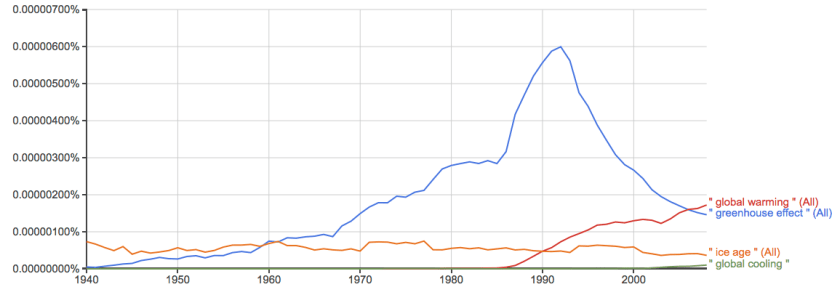
At least, that is my memory. According to the Google Books NGram viewer, though, the “greenhouse effect” was as mentioned in books around 1970 as frequently as it is today; and, oddly, it has declined substantially from a peak three times as high in the early 1990s.Screenshot 2015-12-16 14.22.01

For example, a 1966 book titled Living on Less begins its section on “The Environment” by discussing global warming, and launches right into a description of the greenhouse effect that sounds very similar to what you might read today.

Important punctuation

I had a student recently ask me to send a document that I’d promised a week ago. I sent it immediately, and then she apologised for badgering me about it. I replied

Not at all. My fault.

On reflection, it struck me as a powerful example of the importance of punctuation. It would have been a very different reply had I written

Not at all my fault.

The right to be honoured

The journalist Barbara Ellen, writing in the Guardian, has defended Cambridge historian David Starkey, who has come under attack for his racist remarks:

An open letter to the university, signed by hundreds of staff, students and alumni, accuses Starkey of repeatedly making racist statements. It cites his appearance on BBC Newsnight after the summer riots of 2011 in which he said: “A substantial amount of the chavs have become black. The whites have become black; a particular sort of violent destructive, nihilistic gangster culture has become the fashion.”

It also cited a more recent interview in the Telegraph in which Starkey said statistics “appeared” to show a black propensity to violence.

A twofer: He insulted all black people, and simultaneously applied an insulting term for the white working class. Ellen protests

Free speech is one of the most precious facets of British society, but here is proof that, for some, it is all too dispensable. The pre-emptive ban is replacing the enriching debate. Nuance and difference are being hounded into the shadows.

How long before society reaches a state of self-monitoring, self-censoring “offence-Stasi”, with everyone on permanent red alert?

That sounds terrible. Starkey was “pre-emptively banned” merely for making perfectly ordinary disparaging remarks about black people. What was he banned from? Appearing as the leading spokesman for one of the world’s most esteemed universities in a promotional fund-raising video. That’s exactly the sort of thing that used to go on in communist police states. Continue reading “The right to be honoured”

Politicians debate statisticians and philosophers

I should have known the writing was on the wall for my career in Canada when, at the first federal election debate in 2006, the Bloc Québécois leader Gilles Duceppe said

We don’t need inspectors. We don’t need statisticians. We need doctors and nurses.

The rest of academia kept their heads down, hoping the storm would blow over. But now, not even a decade later, just south of the border, presidential candidates have another academic discipline in their sights. In yesterday’s Republican presidential debate Marco Rubio said

Welders make more money than philosophers. We need more welders and less philosophers.

As is pointed out here, the first statement isn’t actually true. Whether it should be true is another question. We might say, a philosophical question; although, in a serious dispute over the issue between a philosopher and a welder, I would not be surprised if the latter came out the better for it.

First they came for the statisticians…

Fat and spinach

There’s an old joke — I’ve seen it attributed to Clarence Darrow, but I have no confidence in this attribution — that goes

I don’t like spinach, and I’m glad I don’t, because if I liked it I’d eat it.

I thought of this in reflecting on the lessons of Nina Teicholz’s book Big Fat Surprise, about the sorry history of public health recommendations about dietary fat, mainly in the US. This will surely go down as one of the most embarrassing disasters in public health history, so Teicholz’s efforts to uncover how a supposedly self-correcting process was able to go so badly wrong holds important lessons for all of us who care about either science or public policy. (It’s sort of The Innocence Project, with observational studies in place of eyewitness misidentification.) Continue reading “Fat and spinach”

The Shabbat automobile (and other regulatory subterfuges)

It reminds me of the questions that folklorist Alan Dundes raised in his book The Shabbat Elevator and other Sabbath Subterfuges: Why do Orthodox Jews adopt enormously rigid strictures on every element of their lives, and then devote enormous energy and creativity to evading them, as when they tie a string around a whole neighbourhood to make an eruv, defined to be a single residence for purposes of the law that bans carrying objects in a public domain.

One could well ask, if a set of customs is deemed overly oppressive, why not simply repeal or ignore them?

At least they can argue that repeal isn’t really an option when you’re talking about divine law. But what about automobile pollution regulations?

Amid all the attention focused on Volkswagen’s bizarre cheating on diesel emissions tests — which ought to, but probably won’t, lead to multiple executives spending long terms in prison — some interesting lessons about the general nature of regulations and testing threaten to be submerged. As many have pointed out, real diesel emissions are many times higher than those permitted by regulations. The tests are routinely evaded, if not always as creatively as Volkswagen has done. Some examples: Continue reading “The Shabbat automobile (and other regulatory subterfuges)”