Nationalist health service

I’ve been appalled at the leaflets delivered to our home by the Leave campaign. 16-06-2016, 11 44 37

They prominently use the blue and white NHS logo, as though this were official health-service literature, rather than being a political message from people who have never been friends of the NHS before, and are unlikely to be so in the future. It amazes me that they would be permitted to use the logo, or more likely are simply so brazen as to use it without permission.

Their argument, if we can call it that is that without spending on the EU, the UK could build a new hospital every week. Of course, they don’t have enough nurses to adequately staff even the hospitals they have, much less the 200+ new hospitals they promise to build by 2020, and without the East Europeans the staffing crisis will only get worse.

16-06-2016, 11 43 18

How to do racist things with words

In contemplating the state of political discussion on the right wing of US politics, I found myself thinking about the celebrated work How To Do Things with Words, by the linguistic philosopher J. L. Austin.

I’ve been trying to understand the way Republicans talk about Donald Trump. For months mainstream Republicans have been predicting that Trump would “pivot” toward the general election and adopt a more “presidential” tone.  “Pivot”, a term that usually describes a turn away from the interests of ideological allies in ones own party toward emphasising more centrist positions, but in the special context of this presidential election means ceasing to make racist attacks and boasting about penis size.

Republicans don’t like Trump’s open racism. You might think they would then not support him. Or (and I’m not so naive as to miss their inescapable self-interest in continuing to support him) if they find his racism just embarrassing but not inherently a problem they might publicly condemn it, while privately encouraging him to tone it down, and hope that people will forget. Instead, though, they are publicly encouraging him to stop making racist comments. For example, Senate Majority Leader Mitch McConnell said “He needs to quit these gratuitous attacks on other Americans”, and said “Donald Trump has got a lot of good qualities, but he needs to put them forward and suppress some of these other actions.” Senator Bob Corker said Trump has “two or three weeks” to “pivot to a place where he becomes a true general election candidate.” Continue reading “How to do racist things with words”

Not half bad

Lauren Fox at TPM reports on Republican efforts to reassure voters that there’s no need to worry about President Trump’s authoritarian impulses, because he will be constrained by Congress and the courts. One of these comments includes an odd rhetorical slip. There is a family of expressions in English constructed in the form “If A is only half as X as they say, then Y.” The Y is some extreme outcome, the intended effect being to suggest that the reports are so uniformly extreme, that even if we discount half of it the result is still pretty strong — either positive or negative. If she’s only half as good as they say, she’ll beat everyone on our team. If the storm is only half as strong as the predictions suggest, this shack isn’t going to survive.

But Republican strategist John Feehery is quoted as saying

I am not of the opinion that the Republic would fail if the voters select somebody like Trump and if Trump turns out to be half as bad as some conservative pundits would have you believe, there are plenty of legal mechanisms to either contain his worse impulses (the Congress and the Supreme Court, for example) or remove him from office should his transgressions become too toxic.

It’s good to know that the Republic will survive if Trump turns out to be half as bad as some conservative pundits suggest. He’s not making any guarantees if Trump turns out to be three-quarters or even fully as bad as some conservative pundits suggest. And if he’s anything like what liberals expect, we’re doomed.

On a related matter, when I hear the Senate majority leader justifies his endorsement of a wannabe strongman by promising “No matter how unusual a personality may be who gets elected to office, there are constraints in this country”, I can’t help but be reminded of the famous comment of Franz von Papen, leader of the Centre Party in the Weimar Republic,

Wir haben ihn uns engagiert. … Was wollen sie denn? Ich habe das Vertrauen Hindenburgs. In zwei Monaten haben wir Hitler in die Ecke gedrückt, dass es quietscht…

We hired him to work for us. … What’s the problem? I’m the one who has [President] Hindenburg’s confidence. In these two months we have completely backed Hitler into a corner.

Revolution as entertainment

I was just reading this article about how the UK farming minister told the Guardian that British withdrawal from the EU, would be a godsend to the environment:

If we had more flexibility, we could focus our scientists’ energies on coming up with new, interesting ways to protect the environment…

“New and interesting” sounds good, but these hardly seem like essential criteria for environmental protection laws. “Safe” and “effective” seem more appropriate. I’m happy to leave it to Hollywood to entertain me, if EU environmental policy will just, you know, protect the environment.

An even more extreme example of the craving for politics to fill the boring spaces in an empty existence is this Bernie Sanders supporter who was quoted in a recent NY Times article:

Victor Vizcarra, 48, of Los Angeles, said he would much prefer Mr. Trump to Mrs. Clinton. Though he said he disagreed with some of Mr. Trump’s policies, he added that he had watched “The Apprentice” and expected that a Trump presidency would be more exciting than a “boring” Clinton administration.
“A dark side of me wants to see what happens if Trump is in,” said Mr. Vizcarra, who works in information technology. “There is going to be some kind of change, and even if it’s like a Nazi-type change, people are so drama-filled. They want to see stuff like that happen. It’s like reality TV. You don’t want to just see everybody be happy with each other. You want to see someone fighting somebody.”

You can’t say he’s not going into it with his eyes open.

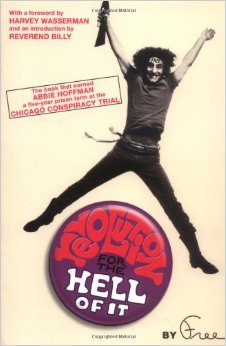
As usual, I blame Abbie Hoffman.Revolution for the Hell of It


Popularity contest

People talk about Hillary Clinton’s poll-reported unpopularity as though it represented some natural fact about her. A failure of character, or a judgement on her weakness as a politician or human being. But it hasn’t always been that way. Just to check my memory, I looked up Gallup’s record: In April 2013 64 percent of Americans surveyed had a favorable impression of her, as against 31 percent with an unfavorable impression. In May 2016 it was nearly reversed: 39 percent favorable, 54 percent unfavorable. Were there dastardly revelations about her character or public conduct in the interim?  Or did she just happen to be the frontrunner in an ideologically heated Democratic primary? (By pure coincidence, the last time her relative favorability was negative was October 2000. I can’t remember what was going on then…)

As for Donald Trump (“Businessman Donald Trump”, as Gallup terms him) there has been only one Gallup survey — in June 2005 — that gave him a positive margin (51 to 38, so it wasn’t even close). Otherwise, every Gallup survey since they first asked about him in 1999 has negative favorability, usually by a wide margin.

Rapid growth

A lot of EU citizens who live in Britain are worried that they will be forced out if the UK voters decide next month to withdraw from the EU. The Leave campaign dismisses this, and all concerns that anyone might have about this radical step, as “Project Fear”:

Clearly any EU citizen that is legally here if we come out of the EU would absolutely have the right to remain here. Any other suggestion is just absurd.

Given that the main point of Brexit is to reduce immigration from the Continent, and given that tempers are likely to flare when the fate of said migrants (on both sides) are negotiated, and given that current UK law clearly would not give most of the EU citizens who are here the right to permanent residency, it’s clearly not absurd to worry. To adapt an old saw, even those whom political campaigners are trying to make paranoid, have real reasons to worry.

Well, from the NY Times, here’s some non-evidence:

Rose Carey, the head of immigration at Charles Russell Speechlys, a global law firm based in London, said she had seen an “unprecedented amount” of applications for British citizenship in the last few months.

“Historically, E.U. nationals didn’t really bother applying for a British passport,” she said. “It used to be a couple hundred a year to now five queries a week.”

From a couple of hundred a year to five a week — that’s pretty rapid growth!

“Different methods”

Boris Johnson, proud of his subtle grasp of history, and of the Second World War in particular, has contributed to the Brexit debate by comparing the EU to the Third Reich:

“Napoleon, Hitler, various people tried this out, and it ends tragically,” he says. “The EU is an attempt to do this by different methods.”

I appreciate that goals and intentions are important, but one would tend to think that at some point, if the “methods” are sufficiently different, it does make a qualitative difference. Otherwise, one could attack the government’s attempts to calm ethnic tensions, and the grounds that Hitler also tried to resolve ethnic tensions through “different methods” (genocide rather than dialogue). Policies to ensure that businesses can find qualified workers? Sure, if you look at the details, improved education opportunities sound better than enslavement, but it’s really just quibbling over different methods.

Or plans to build motorways… well, I guess the methods weren’t particularly different, so that’s just fascist through and through.

Complete impartiality

Conservative advocates of Brexit are angry that experts whose job it is to protect the stability of the British economy are proving so stubbornly… conservative. Their narrow-minded equations only respond to the boringly conventional changes in tariffs, consumer confidence, investment flows, and the like, and seem to have no place for the growth-multiplying effect of exuberant national sense of purpose and untrammeled Britishness. The most recent offender is Bank of England governor Mark Carney (himself dangerously colonial), last seen protecting Britishness by warning the Scots of the financial implications of their own leap into national autonomy. He warned that a vote to leave the EU could devalue the pound and initiate a recession.

The Conservative Brexit response:

Andrea Leadsom, a Conservative energy minister, accused the Bank’s governor, Mark Carney, of disrupting the markets and jeopardising his independence… “It is institutional ganging up on the poor British voter who is trying to get a decent primary school place and doctor’s appointment.”

The Bank of England governor had “come out with some nonsense that is totally unjustifiable, totally speculative stuff” and predicted that he would be wishing that he had not done it, she said…

Jacob Rees-Mogg, a backbench Tory MP, said Carney should be fired and had become highly politicised in what was meant to be an impartial role.

Yes, we need to protect the impartiality of the Bank of England by firing its governor when his advice supports one side in a political argument.

Gay Paree

I’m wondering how to understand the comments of David Cameron in the House of Commons, disparaging Nigel Farage for pronouncing his name to rhyme with massage and not to rhyme with… well, disparage. Except that what he said was (in reference to a comment on NF by another MP)

I’m glad he takes the English pronunciation of Farage rather than the rather poncey foreign-sounding one that he seems to prefer.

Now, ponce is one of those English expressions that I’m sort of familiar with, but not sure I get the nuance of. I understand it to be a term of ridicule for effeminate or homosexual men, and the OED agrees (though the earliest meaning seems to be pimp or kept man). But I’m not sure whether that’s the current understanding that natives have of the word. So I’m not sure whether Cameron’s comments ought best to be understood as gay-baiting, French-baiting, or a twofer where the French are mocked for being gay and the gay are mocked for being French. And Farage is mocked for being both. There are times when Cameron can’t resist reminding everyone that he was at Eton.
I’ve long been fascinated by the centuries of schoolboy-level taunts, where the British consider the French to be insufficiently masculine and probably gay, and the French think the same of the British.

Taking the lead

The BBC has a surprising headline:

Screenshot 2016-04-15 11.30.25

Leading financial institutions welcomed a crackdown on tax dodging? That’s a surprise. Which institutions are these? Goldman Sachs? Deutsche Bank? Maybe UBS? Well, no. What they mean are International Financial Institutions (capitalised), which is a different thing from financial institutions (such as banks) that happen to act internationally and have the world economy by the throat. Government institutions. Somewhat less surprising.

Even the reference to “financial institutions” (plural) is misleading, since the only institution that is mentioned by name in the article is the IMF. Maybe the World Bank requested anonymity.