
Less than zero: A new reckoning

One of the most important lessons I ever learned about capitalism and the nature of wealth I learned from Donald Trump. And now I discover that I was entirely misled, at least as regards Trump’s particular role.

As I discussed in a post a couple of years ago, back in the 1990s I read a newspaper article about Donald Trump’s most recent bankruptcy, and was struck by the fact that, despite having vastly more liabilities than possessions, Trump was still treated as a wealthy man, and not worse than a pauper. And his creditors were willing to come to an arrangement that allowed him to live a rich-man lifestyle, if somewhat less opulent than before. I understood that to mean that modern capitalism makes debt almost as valuable as property, that the person with a billion in debt and the person with a billion in property are considered to be much more similar to each other than either is to the one who has neither debts nor wealth.

Now, having read several books on Trump, including most recently Seth Hettena’s Trump/Russia: A Definitive History, I see that this beautifully esoteric interpretation must yield — at least in the case of Trump — to a simpler and crasser interpretation: At various stages of his career Trump has been propped up by criminals who found the Trump Organisation, and its self-absorbed empty-headed chief, too useful as a cover for moneylending — first for the New York mob, then on a larger scale for Russian oligarchs and criminals from the former Soviet Union — to let it fail. In some sense, this is the value of debt: When there are large numbers in play, it’s easy to hide smaller numbers, just as long as you can come to an agreement to keep the flow going. And it does take a special kind of person to have managed to accumulate that amount of debt in the first place, making Trump’s debt truly a rare and valuable commodity.

I’m perfectly willing to accept a certain claim of innocence, that Trump believed all along that the fact that he kept managing to steer around failure demonstrated nothing but his unique genius. It reminds me of Hitler’s famous comment “Ich gehe mit traumwandlerischer Sicherheit den Weg, den mich die Vorsehung gehen heißt”: I follow, with the certainty of a sleepwalker, the path that Providence has laid out for me.

That narcissistic naïveté probably was, and remains, his most useful quality. First time tragedy, second farce.
Why Israel?

The Guardian has published an “exclusive” on the future of European science funding after  Brexit. The key point:

A draft copy of the so-called Horizon Europe document, seen by the Guardian, suggests that the UK is set to be offered less generous access than countries with associate status in the current programme, known as Horizon 2020, including Israel, Turkey, Albania and Ukraine.

So why does the headline say

Brexit: UK may get poorer access than Israel to EU science scheme

Why Israel? If I had to pick a country on the list whose prominence in scientific research makes it seem insulting that they would have a higher priority in research collaboration than the UK, it might be Albania. It definitely wouldn’t be Israel. So might there be some other reason why The Guardian wants to highlight for its readers the shame of being treated worse than Israel by the EU?

From the archives: Charitable giving to universities

With The Guardian portraying the magnitude of Oxford and Cambridge college endowments on the front page as a major scandal — though taken all together they don’t reach even half of the endowment of Harvard — it seems like a good time to repost this comment I made five years ago, when the government was being attacked by Oxford’s chancellor for considering limiting the tax deduction for charitable donations to educational institutions. The post begins:

Let’s think this through:

  1. The government wants philanthropic funding of universities to replace public funding.
  2. Under current law, contributions to universities (and other charities) are matched by a 40% tax rebate for higher-earning taxpayers, so 2/5 of the costs of nominally “private” contributions are actually paid by the taxpayers. The government proposes to cap this subsidy at 15% of income or  £20,000.

Do you see the contradiction? Neither do I. In a time when the government is cutting funding for all manner of worthy projects, it seems pretty undemocratic to effectively allow wealthy citizens nearly unlimited access to the treasury to support their own favourite causes. The £560 million in charitable gifts last year presumably included more than £200 million in “gift” from the government. Whether or not this is a good thing, it seems troubling, as a point of democratic principle, that control over these £200 million has been passed from the citizenry at large (in the person of their elected representatives) to the infamous “one percent”.

For the rest, see here.

I think everyone would agree that if the wealthy elite want to spend their money on providing luxury education in medieval buildings to particularly talented young people, many but not all of whom come from privileged backgrounds, that’s probably not the most useless or antisocial thing that they’re free to do with their money. (And I can confirm, from personal experience, that Oxford colleges spend insane sums of money on maintenance for their buildings.) But as long as they’re leveraging public funds, which the current government has decided to withhold from educational institutions that serve a broader public far more efficiently, it’s no longer a simple matter of private choice.

Willfully misleading

A Home Office spokesman says

It is wilfully misleading to conflate the situation experienced by people from the Windrush generation with measures in place to tackle illegal immigration and protect the UK taxpayer.

Not just misleading, but willfully. There’s no possible way anyone could honestly see a connection between a policy of “hostile environment” (their words) for undocumented immigrants — effectively deputising the health service and every landlord to act as amateur immigration sleuths — and the mistreatment of members of a minority ethnic group whose immigration status has been kept deliberately ambiguous.

One of the celebrated cases reported in The Guardian was that of a man whose radiotherapy for prostate cancer was cancelled because he couldn’t prove his legal residency, despite having lived in the UK for 45 years. It’s hard to imagine that his skin colour and accent played no role in the hospital’s decision to question his status. It reminded me of a question I’ve considered several times: How can a native-born British citizen prove his or her right to be here? Everyone born since birthright citizenship was eliminated has been subject to jus sanguinis, with citizenship conditional on their bloodline. If you’re 30 years old and your landlord is asking you to prove your right to reside in the country, what do you do? Call your parents and ask for their birth certificates? If your parents are John and Mary Smith, how do you prove that they’re your parents? We’re gradually coming to a generation that will need to prove their grandparents were citizens. Registration of citizens and ID cards would resolve the problem, but the Tories got rid of those, suggesting they would infringe on personal liberty. As I commented before, the Conservatives have a stereotype of Nazis demanding people’s “papers”, and decided that the evil was not that disfavoured individuals were punished for not having correct papers, the offense was to provide them with papers in the first place.

Jared Kushner thinks ahead on prison reform

One of the oddest trends of the latter half of the odd 1970s in the US was the transformation of law-and-order conservatives like Charles Colson and even G. Gordon Liddy into prison-reform advocates, after they had spent some time themselves in federal prison for their role in the Watergate scandal. The President’s son in law isn’t waiting. Congress is considering a package of reform measures to improve federal prison training programmes, and increase the possibilities for early release for good behaviour. Reports are that Kushner has taken time out of his busy schedule making peace in the Middle East and solving the opioid crisis to lobby for the bill. JK is, of course, famously well behaved. What good is advocating prison reform if it comes too late for you to take advantage of it?

I wanna hold your (geopolitical) hand

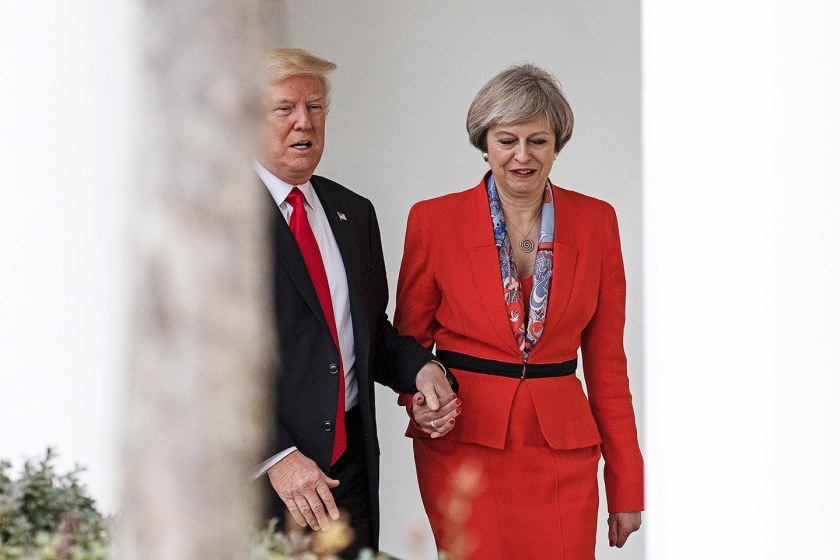
The trans-Atlantic romcom goes into its next season. We recall the highlight of last season, when Theresa and Donald were sharing a personal moment in their “special relationship”.

donald-trump-theresa-may

At the start of the new season, Melania confirms that she really would rather hold almost anything than Donald’s hand:

Theresa was dancing around Number 10, like, “I can have him all to myself.” But then this French dude came into the picture.

5568

They look so happy together. Macron is even boasting about their “very special relationship”. And Theresa is saying, but Donald, I thought our relationship was the special one. I left Europa for you…

Do loony leftists use the right-hand rule?

So Leave.EU is still active, and apparently last year they were soliciting a graphic to ridicule journalist Carole Cadwalladr:

As a mathematical scientist it strikes me as significant that she is considered to be discredited by association with three images: Flat Earth, Illuminati (though it looks to me like the Masonic eye from the US dollar bill), and what looks like a cheat sheet for an introductory electromagnetism course. Down in the corner we see that she’s been learning the right-hand rule for multiplying vectors. Right above it she has the formula for calculating power, which seems problematic.

The president’s dilemma

In the classic prisoners’ dilemma, two members of a criminal gang have been caught by police. There is enough evidence to convict them of minor crimes, but without testimony from one of them they will receive only a light sentence, say one year in prison. If one of them agrees to cooperate with the investigation, prosecutors will let him out for time served, and be able to send the other to prison for ten years. But if they both cooperate with the investigation, both will go to prison for five years (perhaps because the prosecutors will have their information, but not their testimony). Key to the game is that the players are unable to coordinate their strategy. Clearly the best for both of them would be to keep quiet, but the strategy of cooperating with the investigation is superior, from their private perspective, regardless of what the other player does. So they both talk, and both get heavy sentences.

One weird thing about the story here is that the symmetry really doesn’t make sense. It’s not impossible, but it’s peculiar to imagine prosecutors being so interested in pinning the major crime on someone that they’re willing to let a confederate walk free, but indifferent to who flips on whom. That suggests we consider a less-known hierarchical version of this game, where one player is the powerful boss of a crime syndicate — let’s call him “The President” — and the other one is “The Attorney”, who knows all the details of his crimes, and is sufficiently involved to be criminally liable himself. Let’s call this game “The President’s Dilemma”. Continue reading “The president’s dilemma”

Suspicious precision

Kevin Drum notes some tweets from lawyer Susan Simpson. She was perusing (as one does) the public records of Trump campaign expenditures, and noticed something funny:

To me it looks almost too exact. Is Michael Cohen, in trying to cover up a $130,000 transfer, really incapable of seeing that $129,999.72 looks suspiciously close? Couldn’t he at least swallow, I don’t know, a $20 loss and make it $129,981.34?

The magical zero marginal

There’s no knowledge like secret knowledge… Prominent in today’s news is Labour’s contention that

leaked Home Office documents suggesting government cuts are linked to the rise in violent crime, and demanded the home secretary explain herself to parliament.

It’s a bizarre accusation, not because it is implausible, but because it could not be otherwise, and the suggestion that this has been “revealed” by a secret report is part of implicitly accepting an inane pattern of government — and not just government — obfuscation that I am choosing to call the magical zero marginal. The way it works is, the government (let us say) feels an urge to reduce expenditures on (let us say) policing. It’s a problem, because the voters rather like police, by and large, and feel that they derive benefit. Not to worry, says the government press release (possibly produced by a dedicated key on the Whitehall keyboard), there will be no reduction in service. The costs will be made up with efficiency gains. The claim is that there is a significant portion of the current budget that is bringing zero marginal benefit, and whose elimination will therefore cause no harm. Perhaps this portion doesn’t exist as a budget line item now, but will after a “reorganisation” — but then the implicit claim is that the costs of the reorganisation as well will be covered by the savings. Continue reading “The magical zero marginal”