
Quantum babble

Here’s  a recent article from New Scientist about the discovery — creation, actually — of a new kind of particle called the “Majorana fermion” that physicists have supposedly been searching for for 75 years (who knew?!)

I more or less trust New Scientist, so it’s presumably legitimate, but it’s amazingly close to a parody of quantum gobbledegook. I know more than the average person about quantum physics, but I really can’t tell if someone’s pulling my leg here. I could just as well imagine this having been scribed by Stanislaw Lem, and it wouldn’t be entirely out of place as a wonky Spock-Kirk colloquy in Star Trek, explaining how hyperwarp communications or something functions.

What is a Majorana fermion?

It is named for the physicist Ettore Majorana, who found that a particle could be its own antiparticle.

If a particle has properties with values unequal to zero, then its antiparticle has the opposite values. What that means is that all the properties of a Majorana fermion, the charge, energy, what have you, it’s all zero. It is a particle, but it doesn’t have properties that we can measure. That makes it very mysterious. It also makes it difficult to find.

How did you find the Majorana?
We made one. The Majorana comes out of the superposition of an electron and a “hole” – the absence of an electron in a metal. By applying a magnetic field to semiconducting nanowires laid across a superconductor, you can move electrons along these wires, creating two points in space that each mimic half an electron. The electrons go back and forth, so the hole jumps from left to right. If it spends an equal amount of time on each side, then, quantum mechanically, it’s in a superposition of being on the left and right. If it’s stable, then we call it a particle.

I’ve had graduate level courses in relativistic quantum mechanics, but I can’t tell if this is a joke.
Politics and Plagiarism in Germany

There’s a new plagiarism scandal in the German Bundestag! [link in German]

“A nation reveals the nature of its political culture in its choice of scandals.” That’s not a maxim, but it ought to be. I first thought of it in 1992, when the German economics minister and vice-chancellor Jürgen Mölleman was forced to resign because of what was called the “Letterhead affair”: He had used departmental stationary to write in support of a relative’s business marketing to wholesalers a plastic chip that shoppers could keep in their wallets and use instead of a 1-mark coin as the deposit on a shopping trolley. “A clever idea!” he enthused. (“Eine pfiffige Idee.”) At the time I thought it reflected well on German politics, that they could hatch a scandal of such unrelieved banality; I compared it with Italy, where at the same time politicians in the pay of organised crime barely rated a mention in the national news unless underaged prostitutes were involved.

In the past couple of years the German government has been repeatedly roiled by plagiarism scandals. What? I hear you cry. How can a politician commit plagiarism? (Barack Obama refusing to admit that his first book was ghostwritten by Mumia Abu Jamal isn’t plagiarism.) Okay, there was Joseph Biden cribbing his stump speech from Neil Kinnock, but plagiarism is one of those crimes that only certain people can commit — like adultery, or violating the secrecy of the confessional — and those people are writers and academics. Politicians aren’t paid for original turns of phrase. Continue reading “Politics and Plagiarism in Germany”

Avastin didn’t fail the clinical trial. The clinical trial failed Avastin.

Writing in the NY Times, management professor Clifton Leaf quotes (apparently with approval) comments that ought to win the GlaxoSmithKline Prize for Self-Serving Distortions by a Pharmaceutical Company. Referring to the prominent recent failure of Genentech’s cancer drug Avastin to prolong the lives of patients with glioblastoma multiforme, Leaf writes

Doctors had no more clarity after the trial about how to treat brain cancer patients than they had before. Some patients did do better on the drug, and indeed, doctors and patients insist that some who take Avastin significantly beat the average. But the trial was unable to discover these “responders” along the way, much less examine what might have accounted for the difference. (Dr. Gilbert is working to figure that out now.)

Indeed, even after some 400 completed clinical trials in various cancers, it’s not clear why Avastin works (or doesn’t work) in any single patient. “Despite looking at hundreds of potential predictive biomarkers, we do not currently have a way to predict who is most likely to respond to Avastin and who is not,” says a spokesperson for Genentech, a division of the Swiss pharmaceutical giant Roche, which makes the drug.

This is, in technical terms, a load of crap, and it’s exactly the sort of crap that double-blind randomised clinical trials are supposed to rescue us from. People are generally prone to see patterns in random outcomes; physicians are probably worse than the average person, because their training and their culture biases them toward action over inaction.

It’s bizarre, the breezy self-confidence with which Leaf (and the Genentech spokesman) can point to a trial where the treatment group did worse than the placebo group — median survival of 15.7 months vs. 16.1 months — and conclude that the drug is helping some people, we just can’t tell which they are. If there are “responders”, who do better with Avastin than they would have otherwise, then there must also be a subgroup of patients who were harmed by the treatment. (If the “responders” are a very small subset, or the benefits are very small, they could just be lost in the statistical noise, but of course that’s true for any test. You can only say the average effect is likely in a certain range, not that it is definitely zero.)

It’s not impossible that there are some measurable criteria that would isolate a subgroup of patients who would benefit from Avastin, and separate them from another subgroup that would be harmed by it. But I don’t think there is anything but wishful thinking driving insistence that there must be something there, just because doctors have the impression that some patients are being helped. The history of medicine is littered with treatments that physicians were absolutely sure were effective, because they’d seen them work, but that were demonstrated to be useless (or worse) when tested with an appropriate study design. (See portacaval shunt.)

The system of clinical trials that we have is predicated on the presumption that most treatments we try just won’t work, so we want strong positive evidence that they do. This is all the more true when cognitive biases and financial self interest are pushing people to see benefits that are simply not there.

Gambling and finance: The 17th century view

I’ve commented on the peculiar dissipation in recent times of the moral stench of gambling, particularly as practiced by the quant elite, who seem at times to revel in their role as gamblers. But I discover now that I was preceded by more than 3 centuries by Daniel Defoe, in his brilliant Essay on Projects:

Wagering, as now practised by politics and contracts, is become a branch of assurances; it was before more properly a part of gaming, and as it deserved, had but a very low esteem; but shifting sides, and the war providing proper subjects, as the contingencies of sieges, battles, treaties, and campaigns, it increased to an extraordinary reputation, and offices were erected on purpose which managed it to a strange degree and with great advantage, especially to the office-keepers; so that, as has been computed, there was not less gaged on one side and other, upon the second siege of Limerick, than two hundred thousand pounds.

This last extraordinary remark, that people were wagering vast sums on the outcomes of sieges. (£200 thousand in the 1690s is probably like £20 million today, or $30 million.) And he goes on to use gambling on the outcomes of siege warfare to present a fascinating example of a sort of arbitrage called a “dutch book”: Combining different wagers with different parties so as to obtain a cumulative certain profit. (De Finetti’s “Dutch Book Theorem”, stating that you need to calculate with something indistinguishable from the standard rules of probability if you don’t want to fall victim to someone else’s dutch book, is the basis of certain approaches to the foundations of probability.) Continue reading “Gambling and finance: The 17th century view”

Research impact and road construction

I’ve been interested in the turn of government funders of scientific research in several countries — in particular, US, UK, and Canada — to target research spending likely to have high economic benefit. I’ve commented here on Canadian developments, and satirised UK impact obsession here (though I actually think the UK bureaucracy has done a fairly good job at diverting the ill-informed government rhetorical pressure into less harmful directions). Lawrence Krauss, writing in Slate, has pulled together some of these recent developments with some interesting commentary.

One interesting analogy has recently occurred to me: Scientific research is a public good, like roads. I’m no expert on transportation policy, but my impression is that when transportation plans are laid, when they decide to invest the necessary capital in widening this highway, or paving that cowpath, the political decision-makers don’t devote a lot of energy to questioning whether it’s really productive for people to be travelling along this route, whether people going from A to B (and back) is actually going to provide economic benefits. The arguments usually stop at the evidence that people are travelling that route, that the current roads are congested, and so on. Experience has shown that efficient transportation infrastructure promotes economic growth and general public welfare, and government should provide people with the means to get where they want to go reasonably quickly and safely, without needing to micromanage exactly why everyone wants to go wherever it is they want to go.

Similarly, experience shows that thriving scientific research promotes economic growth, and public welfare, and we should invest in making it thrive. Where should we invest? We should look where the traffic is going, and not ask why it is going there.

This is not quite as straightforward as the road-building problem, because we do want to distinguish between high-quality research and low-quality research, but even a certain amount of boring, non-paradigm-breaking, grey-skies research can play an important part in keeping the scientific enterprise healthy. Making this distinction is the job of peer-review, and maybe it needs to be done differently, but I would contend that trying to slather on another layer of “impact” evaluation is not going to make the process or the research more productive.

Impact à la canadienne

I’ve mocked the sometimes risible implications of the British obsession with tying academic research one-for-one with “impact” on industry or society. It’s not absurd to want to ask the question, I would argue, but expecting to be able to get answers about impact on the fine grain that is needed for steering funding decisions leads, I suggest, is a fool’s errand. There is also a (not very) hidden political agenda behind impact: Research that elucidates the origin of the Himalayas or the inner workings of modern religious movements, let us say, has no impact unless the BBC makes a documentary about it. Research that helps one bank increase its market share over another bank by better confusing its customers is rewarded for its impact, because definable (and potentially grateful) people have made money from it.

Nonetheless, the British establishment is not so crass as to suppose that helping to make money is the only possible utility of research. The UK research councils are at pains to point to the multiple “pathways to impact”, through changing public understanding, government policy, health benefits, education. For some purposes, even something as useless as influencing the progress of science can be counted as impact, though it fail to swell the bank account of even the smallest party donor.

To see the full unfolding of impact’s crassness potential, we need to look to Canada. John MacDougal, director of Canada’s National Research Council (NRC), announced his agency’s new focus on impact by saying,

Scientific discovery is not valuable unless it has commercial value.

No hedging there about social impact, contributing to public understanding, government policy, etc. Science minister Gary Goodyear  said that

We want business-driven, industry-relevant research and development.

This is not quite as outrageous as astronomer Phil Plait makes it seem, when he contends that “the Canadian government and the NRC have literally sold out science”. And he goes on to say that NRC “will only perform research that has ‘social or economic gain’.” An article quotes Goodyear saying

the government isn’t abandoning basic science, just shifting its focus to commercializing discoveries. “The day is past when a researcher could hit a home run simply by publishing a paper on some new discovery,” he said. “The home run is when somebody utilizes the knowledge that was discovered for social or economic gain.”

Continue reading “Impact à la canadienne”

Who cares about future generations?

Niall Ferguson has gotten a lot of attention lately for having bashed the “effete” J M Keynes for his selfish worldview, which was due to his homosexuality-induced childlessness rendering him indifferent to the fate of future generations. (This was apparently NF’s interpretation of Keynes’s “In the long run we’re all dead” quip, which is such a bizarrely dishonest distortion that it can only be understood as a sort of carry-over of the toff’s empty PPE cleverness into his new life as intellectual masseur to the wealthy; he seems to have momentarily forgotten that his personal brand depends on him maintaining the veneer of an intelligent academic historian.)

Brad DeLong has pointed out that there is a long tradition of right-wing intellectuals slurring Keynes as a pervert, and his economic theories as sharing the taint of his perversion. Where you stand depends on where you sit, though Henry Blodget says it is unheard of for

a respectable academic to tie another economist’s beliefs to his or her personal situation rather than his or her research. Saying that Keynes’ economic philosophy was based on him being childless would be like saying that Ferguson’s own economic philosophy is based on him being rich and famous and therefore not caring about the plight of poor unemployed people.

Maybe that’s true, though plenty of non-economists state openly that the economics Weltanschauung derives from the pampered condition prevailing among its devotees.

But do you know who was really effete and childless and indifferent to the fate of our children and grandchildren and future generations? There was that guy who said this

Take therefore no thought for the morrow: for the morrow shall take thought for the things of itself. Sufficient unto the day is the evil thereof.

and this

Lay not up for yourselves treasures upon earth, where moth and rust doth corrupt, and where thieves break through and steal;

and this

If any man come to me, and hate not his father, and mother, and wife, and children, and brethren, and sisters, yea, and his own life also, he cannot be my disciple.

I can’t wait to see Ferguson and his ideological compatriots go after that guy. I bet they’ll really nail him.

Stephen Wolfram’s longitudinal fables

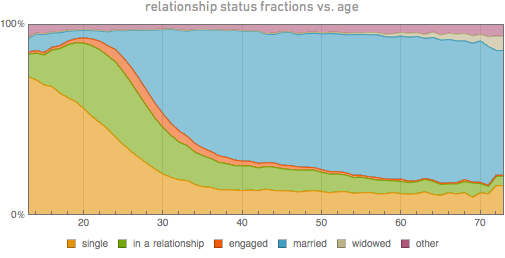
There’s lots of interesting plots on Stephen Wolfram’s analysis of Facebook data, but what jumps out to me is the way he feels compelled to turn his cross-sectional data — information about people’s interests, structure of friendship networks, relationship status, etc. as a function of age — into a longitudinal story. For example, he describes this plotrelationship-status-vs-age2

by saying “The rate of getting married starts going up in the early 20s[…] and decreases again in the late 30s, with about 70% of people by then being married.” Now, this is more or less a true statement, but it’s not really what is being illustrated here. (And it’s not just the weird anomaly, which he comments on but doesn’t try to explain, of the 10% or so of Facebook 13 year olds who describe themselves as married.) What we see is a snapshot in time — a temporal cross section, in the jargon — rather than a description of how the same people (a cohort, as demographers would put it) moves through life. To see how misleading this cross-sectional picture can be if you try to see it as a longitudinal story of individuals moving through life, think first about the right-hand side of the graph. It is broadly true, according to census data, that about 80% of this age group are married or widowed. But it is also true that 95% were once married. In fact, if they had had Facebook when they were 25 years old, their Stephen Wolfram would have found that most of them (about 75%) were already married by that age. (In fact, about 5% of the women and 3% of the men were already in a second marriage by age 25.)

So, the expansion of the “married” segment of the population as we go from left to right reflects in part the typical development of a human life, but it reflects as well the fact that we are moving back in time, to when people were simply more likely to marry. And the absence of a “divorced” category masks the fact that while the ranks of the married expand with age, individuals move in and out of that category as they progress through their lives.

Of course, the same caveat applies to the stories that Wolfram tells about his (quite fascinating) analyses of structure of friend networks by age, and of the topics that people of different ages refer to in Facebook posts. While it is surely true that the surge in discussion of school and university centred at age 18 reflects life-phase-determined variation in interests, the extreme drop in interest in salience of social media as a topic is likely to reflect a generational difference, and the steep increase in prominence of politics with age may be generational as well. (I wonder, too, whether the remarkably unchanging salience of “books” might reflect a balance between a tendency to become less involved with books with age, cancelling out a generational shift away from interest in books.)

Who needs math?

According to a study by sociologist Michael Handel, summarised here by Jordan Weissman, 75% of American workers never use any mathematics more complicated than fractions in their work. (It goes without saying that most partake of recreational calculus, at least on weekends…) Writing in the NY Times last year, Andrew Hacker argued that most schoolchildren are wasting their time learning mathematics: They’ll never understand it, and they won’t be any the worse off for it. As for scientists, the great entomologist E. O. Wilson has recently taken to the pages of the Wall Street Journal to argue that

 exceptional mathematical fluency is required in only a few disciplines, such as particle physics, astrophysics and information theory.

For that matter, even Albert Einstein famously remarked to a schoolgirl correspondent

Do not worry about your difficulties in Mathematics. I can assure you mine are still greater.

But that was after he’d mostly decamped from physics for sagecraft.

Wilson goes on to portray mathematical biologists as technicians, armed with useful tools and useless ideas. And if you need them, you just hire them. (It’s not like they have anything important to do with their time.) So what’s going on? Are mathematicians scamming the public, teaching algebra and other unnecessaries to justify their existence? I would suggest that there are several important issues that these wise men are ignoring or underplaying:

  • It may be true (as Hacker argues) that only a tiny techno-elite actually needs to know how a computer works, or how to compute the trajectory of a spacecraft, or how to program a Bayesian network. But when they’re 11 years old you don’t know who will have the interest or aptitude to join that elite. If you start sieving the children out early because they don’t seem like a likely candidate for that track — and let’s be honest, a lot of the tracking is going to be based on parental status and educational attainment — most of them will have no way to change tracks later on, because of the cumulative nature of mathematical understanding. Worth noting, in this context, is Handel’s observation (cited above) that skilled blue collar jobs are actually slightly more likely to require “advanced maths” (algebra and beyond) than skilled white collar jobs. So you can’t decide who needs the advanced maths based on the kinds of work they’re going into. Those without the education are simply more likely to be stuck at the lower rungs of whatever trade or profession they go into. (On the other hand, a larger fraction of white collar workers are in Handel’s “upper” (skilled) category, so an average blue collar worker probably needs less maths than an average white collar worker.)
  • Mathematics is a language. And what is discussed in that language is, as Hacker recognises, crucial to the fate of everyone in the world. Those who have not learned at least the rudiments of the language are excluded from the conversation. I am reminded of a friend who dismissed the value of learning to speak French, with the argument that “Everyone in France speaks English.” Now, France might have been a bad choice for his claim, but even if it were true, it puts you at a significant disadvantage to be surrounded by people who speak your language, while you can’t decipher their language to understand what it is they’re saying to each other.
  • Think about that Einstein quote: Everyone finds mathematics difficult when they’re pushing beyond their current knowledge. If we’re going to drop mathematics training when it becomes challenging, we might as well stop counting when we run out of fingers and toesies.
  • I would suggest that Wilson may be using more sophisticated mathematics in his work than he is aware. To paraphrase J M Keynes, practical biologists who believe their work to be quite exempt from any need for mathematics, are usually the slaves of some defunct mathematician. Modern biologists of bench and field are often quite attached to some mathematical and statistical machinery that happens to be some years old, and seemed impossibly abstruse when it first seeped in from the pure mathematics or theoretical statistics world. Many of the attempts to apply mathematical techniques in biology (or sociology or economics or whatever) will prove more clever than enlightening, but some will stick, and become part of the basic toolkit that the biologists who think they don’t need any sophisticated math do use. Wilson’s arrogant posture really reflects the fact that there are far more trained mathematicians who are intellectually flexible enough to try and figure out what the biologists are doing, and what the connections might be to their own field, than trained biologists willing to work in the other direction.

The Long Room: An academic allegory

Richard Tames’s A Traveller’s History of Oxford describes the “Long Room” of New College, a range of first-floor latrines built over a huge cesspit. Robert Plot, first superintendent of the Ashmolean Museum rhapsodised in the late 17th century that it was

stupendous… so large and deep that it has never been emptied since the foundation of the College, which was above three hundred years since, nor is it ever likely to want it.

The book also notes that this historical appraisal was in fact erroneous, as the pit had in fact, according to College records, been emptied in 1485.

The author does not make clear whether this description is intended as an allegory of academic productivity.