The first statistician

I like to share with beginning statistics students the aphorism of C. R. Rao

Uncertain knowledge + knowledge about the extent of uncertainty in it = Useable knowledge

And it just occurred to me that the extreme limit of this dictum is that if you are infinitely uncertain, if nothing is knowable, the knowledge of that fact in itself is highly useable. The realisation of which would seem to make Socrates the first statistician:

Well, although I do not suppose that either of us knows anything really beautiful and good, I am better off than he is – for he knows nothing, and thinks that he knows. I neither know nor think that I know. In this latter particular, then, I seem to have slightly the advantage of him. (Apology, translated Benjamin Jowett)

Clushtering

I was somewhat nonplussed by this article in Slate by journalist John Ore, who gives up drinking alcohol every January and had the dubious inventiveness to coin the name “Drynuary” which, he says, has caught on in some circles. What I found odd was that he seems to be plagued by demands to explain or hide the fact that he’s not drinking alcohol.

Everyone who knows me well already understands that I do this Drynuary madness every year—I’m not shy about it, after all—so their immediate reaction is usually an eye-rolling “Again?!” as they pathetically try to peer-pressure me into doing a shot with them.[…]

My wife, and other pregnant friends, have used certain sleight-of-hand tricks early in a pregnancy before they were ready to reveal that they were expecting. She would order the same drink as I would—say, a glass of red wine with dinner—and wait until mine was almost drained. Subtly, we’d switch glasses when no one was looking, and viola! It looked like she was pounding hers, and I was playing catch up.

It seemed odd to me personally because I rarely drink alcohol — and in Oxford that means frequently turning over my wine glass at dinners and drinking orange juice at social events with students — but I can’t recall that anyone has ever asked me why. Maybe it’s a difference between Britain and the US — more universal alcohol consumption here, but less eagerness to intrude on other people’s privacy — but I never had those questions when I lived in the US either. (Once I recall someone expressing surprise that I did drink something alcoholic, but without asking for an explanation. Perhaps I was just not sufficiently sensitive to the implications.)

I recently came upon this plot of alcohol consumption in the US. About 30% consume no alcohol, and the median is about one drink per week. So if Ore were hanging out with average Americans one would have to think that one in three of his companions would also not be drinking, and a second of three might very well pass on the opportunity as well. It wouldn’t seem worth commenting on. But obviously people don’t hang out with random samples of the population. And he specifically says that in his profession — presumably he means journalism — “business events and travel naturally involve expense accounts and the social lubricant of alcohol.” I’ll refrain from commenting on what this might explain about the state of journalism as a profession, but I’m pretty sure that in my profession alcohol definitely doesn’t get to be counted as a travel expense, and in some cases even the bottle of wine shared at a post-seminar dinner needs to be paid for separately because it’s specifically excluded. Continue reading “Clushtering”

We need better scientific fraud

A friend sent me this article about Dutch social psychologist Diederik Stapel, who “perpetrated an audacious academic fraud by making up studies that told the world what it wanted to hear about human nature.” What caught my attention was this comment about how the fraud was noticed:

He began writing the paper, but then he wondered if the data had shown any difference between girls and boys. “What about gender differences?” he asked Stapel, requesting to see the data. Stapel told him the data hadn’t been entered into a computer yet.

Vingerhoets was stumped. Stapel had shown him means and standard deviations and even a statistical index attesting to the reliability of the questionnaire, which would have seemed to require a computer to produce. Vingerhoets wondered if Stapel, as dean, was somehow testing him. Suspecting fraud, he consulted a retired professor to figure out what to do. “Do you really believe that someone with [Stapel’s] status faked data?” the professor asked him.

And later

When Zeelenberg challenged him with specifics — to explain why certain facts and figures he reported in different studies appeared to be identical — Stapel promised to be more careful in the future.

How hard is it to invent data? The same thing occurred to me with regard to Jan Hendrik Schön, a celebrated Dutch (not that I’m suggesting anything specific about the Dutch…) [update: German, as a commenter has pointed out. Sorry. Some of my best friends are Dutch.] materials scientist who was found in 2002 to have faked experimental results.

In April, outside researchers noticed that a figure in the Nature paper on the molecular-layer switch also appeared in a paper Science had just published on a different device. Schön promptly sent in a corrected figure for the Science paper. But the incident disturbed McEuen, who says he was already suspicious of results reported in the two papers. On 9 May, McEuen compared figures in some of Schön’s other papers and quickly found other apparent duplications.

I’m reminded of a classic article from the Journal of Irreproducible Results, “A Drastic Cost Saving Approach to Using Your Neighbor’s Electron Microscope”, advocating that researchers take advantage of the fact that all electron micrographs look the same. It printed four copies of exactly the same picture, with four different captions: One described it as showing fine structure of an axe handle, another said it showed macrophages devouring a bacterium. When it comes to plots of data (rather than photographs, which might be hard to generate de novo) I really can’t see why anyone would need to re-use a plot, or would be unable to supply made-up data for a made-up experiment. Perhaps there is a psychological block against careful thinking, or against willfully generating a dataset, some residual “I’m-not-really-doing-this-I’m-just-shifting-figures-around” resistance to acknowledging the depths to which one has sunk.

Certainly a statistician would know how to generate a perfect fake data set — which means a not-too-perfect fit to relevant statistical and scientific models. Maybe there’s an opportunity there for a new statistical consulting business model. Impact!

Update: Of course, I should have said, there’s an obvious bias here: I only know about the frauds that have been detected. They were unbelievably amateurish — couldn’t even be bothered to invent data — and still took years to be detected. How many undetected frauds are out there? It’s frightening to think about it. Mendel’s wonky data weren’t discovered for half a century. Cyril Burt may have committed the biggest fraud of all time, or maybe he was just sloppy, and we may never know for sure.

I just looked at the Wikipedia article on Burt, and discovered a fascinating quote from one of his defenders, psychologist Arthur Jensen that makes an appropriate capstone for this post:

[n]o one with any statistical sophistication, and Burt had plenty, would report exactly the same correlation, 0.77, three times in succession if he were trying to fake the data.

In other words, his results were so obviously faked that they must be genuine. If he were trying to fake the data he would certainly have made them look more convincingly real.

A small majority

From SPIEGEL’s article about the Oxford PPE degree, where the rich and powerful met when they were only rich and young:

Tatsächlich kommt die Mehrzahl aller Oxford-Studenten von Privatschulen, die sich nur sehr wohlhabende Eltern leisten können: Obwohl nur sieben Prozent aller britischen Schüler auf Privatschulen gehen, machten sie 2013 in Oxford satte 44 Prozent der Studienanfänger aus.

Indeed, the majority of Oxford students come from private schools, that only very wealthy parents can afford: Although only seven percent of British children attend private schools, they were 44 percent of the matriculants at Oxford in 2013.

Even a government minister who studied PPE could tell that 44 percent isn’t a majority…

The article continues, quoting Danny Dorling, on Oxford Geographie-Professor in Oxford as saying

Vier Privatschulen und eine hochselektive staatliche Schule schicken mehr Studenten nach Oxford als die restlichen 2000 staatlichen zusammen genommen…

Four private schools and one highly selective state school send more students to Oxford as the remaining 2000 state schools put together…

I have to assume that this has been misquoted or mistranslated. There are not 2000 (or 2001) state secondary schools, but more than 3000. There are about 6600 undergraduates from state schools and 5200 from private schools. That would mean that at least 1400 undergraduates — about 400 a year — come from this one state school, and presumably a lot more.

My guess is, what he really said (or meant to say) is that these five schools send more students to Oxford than the bottom 2000 schools. Which doesn’t sound so strange, actually. The average number of Oxford places per school is less than one/year. In any given year most schools would send no one to Oxford. Even if schools were all equally good, if there are highly selective schools, they would be expected to send a large number of students to Oxford.

Up is down

I mentioned in an earlier post George Lakoff’s work on metaphorical language. One fascinating issue is the way same metaphorical target can be mapped onto by multiple conceptual domains, and sometimes these can come into conflict — or a metaphor can come into conflict with the literal meaning of the target. When the figurative-literal target conflict is particularly succinct, this tends to be called “oxymoron”. One of my favourites is the 1970s novel and subsequent film about a burning skyscraper, called The Towering Inferno.

This particular one depends on the conflict between the “UP is GOOD, DOWN is BAD” metaphor (an indirect  form of it, since it goes by way of DOWN is BAD is HELL is BURNING), conflicting with the literally towering skyscraper. Anyway, the UP-DOWN dichotomy gets used a lot, creating lots of potential confusion. For example, UP is DIFFICULT and DOWN is EASY, inspiring the famous allegory of Hesiod that inspired so many devotional images:

Vice is easy to have; you can take it by handfuls without effort. The road that way is smooth and starts here beside you, but between us and virtue, the immortals have put what will make us sweat. The road to virtue is long and steep uphill hard climbing at first.

Hence the uncertainty of the phrase “Everything’s going downhill.” Is it getting worse, or getting easier?

There is a triple ambiguity when numbers get involved. LARGE NUMBERS are UP (“higher numbers”, “low number”) when we are counting the floors of a building, but SMALL NUMBERS are UP when ranking (#1 is the winner and comes at the top of the list).

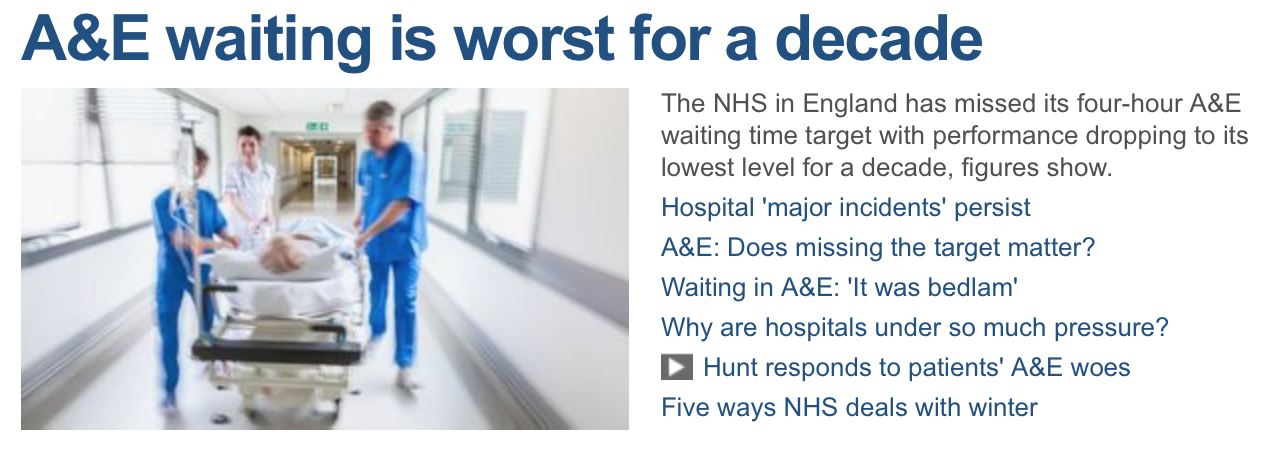
This brings us to the example that inspired this post. The BBC news web site this morning told us that “A&E waiting times in England have fallen to their worst level for a decade.” It’s hard to feel much sense of urgency about the fact that waiting times have “fallen”.

BBC website A&E morning


Presumably that’s why the text had changed in the afternoon:

bbc website afternoon

Aren’t all famous people friends?

By way of Andrew Sullivan, I found this book review by Diane Johnson, referring to

Freud’s friend Arthur Schnitzler’s Dream Novel, the inspiration for the Stanley Kubrick film Eyes Wide Shut…

Poor Schnitzler. He’s one of my favourite authors, and Traumnovelle is one of his masterpieces, but he needs to be put into context for English readers by his connection to two people who are much better known.

I find the Freud hook particularly poignant because Freud was famously not a friend of Schnitzler. They were contemporaries, yes, and neighbours in Vienna. They read each other’s work. But they were not friends. There is one famous letter from Freud to Schnitzler (out of about 10 in total), on the occasion of the latter’s 60th birthday, in which Freud expresses his admiration, and explains why he had never made an effort to meet him. He says it was “Doppelgängerscheu”, fear of meeting his double. Schnitzler used a similar expression some years later in an interview with an American journalist, and he had long been fascinated by Freud’s theories, though also critical.

Freud did invite Schnitzler to his home after that letter, but there seem to have been only a few encounters after that. It would have been more accurate to call Schnitzler’s work “the inspiration for the Stanley Kubrick film Eyes Wide Shut, and the inspiration for many of Freud’s theories of dream analysis”.

The REF Research Rating Agency

Among the many inefficiencies imposed by the hexennial ritual of centralised research evaluation in the UK is the requirement that some of the nation’s most esteemed academics (thankfully, I am not one of these) need to dial their research productivity down to nearly zero while they spend their waking hours — and some when they might otherwise be sleeping — reading and ranking hundreds of papers, and attending interminable meetings. And then, after the results are complete, the specialised skills they have developed during this sisyphean herculean task are of no use to anyone, other than helping their individual departments get a leg up on the next REF, of course. Wouldn’t it be great — and very British — to enable the researchers who have devoted so much time and effort to monetise the skills they have acquired for personal gain?

This is why I am proposing the creation of a public-private consortium (privately owned, but initially funded by the British taxpayers), to be called the REF Research Rating Agency (REFRRA). The idea is simple: One of the major outcomes of the REF is to induce British universities to hire leading researchers away from other British universities shortly before the REF census date, expecting that their 4* papers will pay their salaries for the next six years. They also hire researchers from outside the UK on 20% contracts to pop by occasionally and credit their  research output to their generous UK host. By these means, the University of Birmingham has had itself crowned the king of UK philosophy.

The problem is the amount of guesswork that goes into these hiring decisions. That is why we need the REFRRA, employing experienced former REF examiners, to provide researchers in the UK and worldwide with Audited REF Score Evaluations (ARSE). For a modest fee, academics can purchase a documented ARSE to list on their CV. This will ultimately lead, it is hoped to a complete automation of the appointments process, whereby academics can simply go to a web site of a university they would hope to work for, put in their ARSE and a few demographic details, and receive an immediate job offer or rejection, based on the calculation of whether their hiring would be a financial net gain or loss for the university.

When I told a colleague about this idea, she said that no one could trust ratings where the ones being rated are the agency’s paying customers. Too much conflict of interest. On further reflection we had a good laugh at her naïveté.

James Watson has cashed in his Nobel prize

So can we ignore him now?

Of course, he couldn’t sell the prize, only the medal. But the fact that this deeply mediocre and bigoted mind received so much attention and adulation for so long casts a harsh light upon the scientific cult of genius. Exalted prizes and prestigious chairs often serve a similar purpose to those plaques that we see on buildings around Oxford, marking the place where an important intellectual event once occurred. There might be a frisson to sitting in the room where Robert Boyle discovered the gas law, but you wouldn’t really expect any important scientific insight to come out of it. Continue reading “James Watson has cashed in his Nobel prize”

Math and science

Corey Robin updates us on l’affaire Salaita. I was struck by his comment

Thirty-four heads of departments and academic units at the University of Illinois at Urbana-Champaign wrote a scorching letter to the University of Illinois’s new president[…] Clearly, far from diminishing, the controversy on campus has only expanded.

What’s even more amazing is where it has expanded: three of the signatories are chairs of the departments of chemistry, math, and statistics. The opposition has spilled beyond the walls of the humanities and social sciences. During the summer, lots of folks dismissed this story because the natural sciences weren’t involved. Well, some of them are now.

Math and statistics aren’t really natural sciences, in the crucial economic sense. The people who dismiss the boycott because it’s just the humanities and social sciences are somewhat expressing a sense that those academics are woolly-headed cultural relativists; but even more, I think it’s about the idea that “serious” academics have big grants and big labs and generally deal with big money. Chemistry is the outlier here. Math and statistics are still much more constructed on the same economic model as the humanities, hence barely one step removed from socialism.

The tortoise and Achilles enforce property rights

I’ve commented before about how Lewis Carroll’s “What the Tortoise said to Achilles” identifies a paradigmatic gap between principles and action, which may be summarised as “Yeah, what are you going to do about it?”
I was recently reading Jerome K. Jerome’s brilliant comic memoir “Three Men in a Boat”, which reads like a lost work of Mark Twain, if Mark Twain had been a Victorian English dandy (as, I suppose, he almost was in his later years). There was this account:

We stopped under the willows by Kempton Park, and lunched. It is a pretty little spot there: a pleasant grass plateau, running along by the water’s edge, and overhung by willows. We had just commenced the third course—the bread and jam—when a gentleman in shirt-sleeves and a short pipe came along, and wanted to know if we knew that we were trespassing. We said we hadn’t given the matter sufficient consideration as yet to enable us to arrive at a definite conclusion on that point, but that, if he assured us on his word as a gentleman that we were trespassing, we would, without further hesitation, believe it.

He gave us the required assurance, and we thanked him, but he still hung about, and seemed to be dissatisfied, so we asked him if there was anything further that we could do for him; and Harris, who is of a chummy disposition, offered him a bit of bread and jam.

I fancy he must have belonged to some society sworn to abstain from bread and jam; for he declined it quite gruffly, as if he were vexed at being tempted with it, and he added that it was his duty to turn us off.

Harris said that if it was a duty it ought to be done, and asked the man what was his idea with regard to the best means for accomplishing it. Harris is what you would call a well-made man of about number one size, and looks hard and bony, and the man measured him up and down, and said he would go and consult his master, and then come back and chuck us both into the river.

In other words, you can accept the principles of property rights as far as the most devoted libertarian would wish to push them, but they still get you nowhere without a plan of action to enforce them.