I feel a need to sharpen the point I made here, about how the Tory need to pander in all directions at once has led them into an incoherent position we might call “the antifascism of fools“. On the one hand, we now have government agents patrolling the London underground, stopping “suspicious” people to demand they show their papers. On the other hand, the government will not actually provide people with the papers they need to show, because that would be tyranny. (They can get passports, but that costs about £80. On the other hand, deporting the poor might alleviate the shortage of affordable housing in London. I hear the Falklands are nice this time of year.)
It’s as though a government were to set up concentration camps and secret police, but run down the rail service because making the trains run on time is what fascists do. (Although, come to think of it, that’s not a bad description of recentdevelopmentsin the US…)
Here’s a recent article from New Scientist about the discovery — creation, actually — of a new kind of particle called the “Majorana fermion” that physicists have supposedly been searching for for 75 years (who knew?!)
I more or less trust New Scientist, so it’s presumably legitimate, but it’s amazingly close to a parody of quantum gobbledegook. I know more than the average person about quantum physics, but I really can’t tell if someone’s pulling my leg here. I could just as well imagine this having been scribed by Stanislaw Lem, and it wouldn’t be entirely out of place as a wonky Spock-Kirk colloquy in Star Trek, explaining how hyperwarp communications or something functions.
What is a Majorana fermion?
It is named for the physicist Ettore Majorana, who found that a particle could be its own antiparticle.
If a particle has properties with values unequal to zero, then its antiparticle has the opposite values. What that means is that all the properties of a Majorana fermion, the charge, energy, what have you, it’s all zero. It is a particle, but it doesn’t have properties that we can measure. That makes it very mysterious. It also makes it difficult to find.
How did you find the Majorana?
We made one. The Majorana comes out of the superposition of an electron and a “hole” – the absence of an electron in a metal. By applying a magnetic field to semiconducting nanowires laid across a superconductor, you can move electrons along these wires, creating two points in space that each mimic half an electron. The electrons go back and forth, so the hole jumps from left to right. If it spends an equal amount of time on each side, then, quantum mechanically, it’s in a superposition of being on the left and right. If it’s stable, then we call it a particle.
I’ve had graduate level courses in relativistic quantum mechanics, but I can’t tell if this is a joke.
On the list of all-time great tautologies (though not quite as pithy as “It ain’t over til it’s over”) comes the comment of UK immigration minister Mark Harper, defending the government’s new policy of stopping foreign-looking people to check their immigration papers:
“‘They are not allowed to do it based on someone’s physical appearance. If, someone, when seeing an immigration officer, behaved in a very suspicious way, that might give us reasonable suspicion to question them,” Harper said. “It’s about how they behave, not what they look like. It’s not about their appearance or their race or their ethnicity.”
That sounds pretty clear: If they behave in a “very suspicious way” there must be a reasonable suspicion. Otherwise their way wouldn’t be very suspicious, would it?
One of the first things the new government did when it came into power was to cancel the previous government’s plan to introduce ID cards, because of fears that, well, people could be stopped on the street and asked to show them. The cards were dismissed as “expensive, intrusive“. I’m glad I’m a real foreigner. I have a card to show when I see an immigration officer and can’t resist behaving in a very suspicious way. British citizens who behave suspiciously (after seeing an immigration officer) have no recourse, and may find themselves waiting months to see an immigration judge.
The Guardian reports on a legal settlement, where a Pennsylvania family whose water supply was contaminated by gas drilling, received a payout for their now useless farm, and a gag order banning anyone in the family — expressly including the children, aged 7 and 10, from “ever discussing fracking or the Marcellus Shale”.
During the proceedings, the attorney representing Range Resources, Williams Gas/Laurel Mountain Midstream and MarkWest Energy, reaffirmed the gag order on the children. “I guess our position is it does apply to the whole family. We would certainly enforce it,” he told the court.
The parents in this case did warn of the limited reach of the court:
We can tell them, they can not say this, they can not say that, but if on the playground…..
I know I have enough trouble getting my own children to stop talking about oil and gas exploration on the playground. It’s hard to imagine any court being willing to enforce an order penalising people for discussing certain topics because of an agreement their parents entered into, but the mere threat (and legal expenses) might intimidate them from ever challenging it.
Imagine the potential: Fundamentalist parents could enter into gag orders with their church, forbidding the children from ever speaking about Darwin or evolution. Many parents would happily sign a gag order blocking their four-year-olds from discussing poopy pants or boogers.
And why stop at one generation? Just imagine if, instead of fighting for the loyalty of consumers, generation after generation, a company like Coca Cola could simply pay current consumers to commit themselves and all their descendants to never mention the name of Pepsi, or any other cola drink. And while we’re selling off the rights of our descendants, we might as well replace the whole problematic student loan market with selling off our firstborn children into slavery. (Perhaps they can be chained to desks in the university admissions office, forced to read through 80 thousand personal essays.)
The whole idea of gag orders disgusts me. Paying someone not to talk about a subject… Why does that remind me of something absurd?…
So, apparently, the Nassau County (New York) Police have a “joint terrorism task force”, and they can monitor residents’ web searches in more or less real time. And they paid a visit to a family that had searched for pressure cookers and backpacks online, as well as having revealed interest in news about the Boston bombing. I’m not an expert, but I don’t think it’s a good idea to go telling everyone that law enforcement is monitoring the contents of web activity. Aside from the fact that the monitoring itself is probably illegal, revealing operational capabilities tends to get people stranded in the holding area of foreign airports, where Americans get stabbed in the back. And it doesn’t matter what your motivations were for revealing the information. (Pressure cookers? Really? The whole reason for using pressure cookers to make bombs is that there are millions of them around, a very large fraction of which will likely never be used to kill or maim civilians. And backpacks.)
The next Edward Snowden should avoid contacting a journalist directly. Instead, he can just tip off local law enforcement to an important national security journalist’s involvement in some nefarious plot, and then feed them with the appropriate keywords that he’s trying to communicate. He’ll probably get a medal.
Meanwhile, they were peppering my husband with questions. Where is he from? Where are his parents from? They asked about me, where was I, where do I work, where do my parents live. Do you have any bombs, they asked. Do you own a pressure cooker? My husband said no, but we have a rice cooker. Can you make a bomb with that? My husband said no, my wife uses it to make quinoa. What the hell is quinoa, they asked.
Again, I’m no expert on interrogation, but I’m just going to hazard a guess that “Can you make a bomb with that?” is not the sort of question that frequently leads to actionable intelligence.
Who knew that things had gotten so intimate between the erstwhile Cold War adversaries? Senator Charles Schumer (of New York) says
Russia has stabbed us in the back, and each day that Mr. Snowden is allowed to roam free is another twist of the knife.
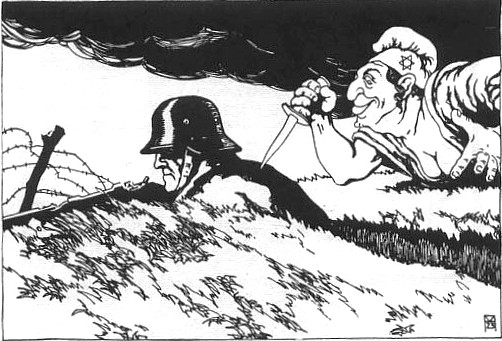
As Mr Schumer surely knows, the “stab in the back” is a favourite antisemitic trope, or more generally a reference to treacherous fellow citizens who are “behind us” because we think we can trust them, while our eyes are focused on the enemy across the border. They are the internal enemy, taking advantage of our attention focused on the external enemy.
1919 Austrian postcard. In Schumer’s telling, Russia is the one on the right.
Now, Russia is a powerful nation, and I hope that the US has a reasonably cooperative diplomatic relationship to it, but I would never have thought it was a US ally.
So, what I want to know is, who screwed up and let the Russians have our backs?
Of course, we wouldn’t have this problem if Snowden (like Bradley Manning) was gay. Maybe we should stop giving security clearances to heterosexuals. It’s too easy for them to get asylum…
“A nation reveals the nature of its political culture in its choice of scandals.” That’s not a maxim, but it ought to be. I first thought of it in 1992, when the German economics minister and vice-chancellor Jürgen Mölleman was forced to resign because of what was called the “Letterhead affair”: He had used departmental stationary to write in support of a relative’s business marketing to wholesalers a plastic chip that shoppers could keep in their wallets and use instead of a 1-mark coin as the deposit on a shopping trolley. “A clever idea!” he enthused. (“Eine pfiffige Idee.”) At the time I thought it reflected well on German politics, that they could hatch a scandal of such unrelieved banality; I compared it with Italy, where at the same time politicians in the pay of organised crime barely rated a mention in the national news unless underaged prostitutes were involved.
In the past couple of years the German government has been repeatedly roiled by plagiarism scandals. What? I hear you cry. How can a politician commit plagiarism? (Barack Obama refusing to admit that his first book was ghostwritten by Mumia Abu Jamal isn’t plagiarism.) Okay, there was Joseph Biden cribbing his stump speech from Neil Kinnock, but plagiarism is one of those crimes that only certain people can commit — like adultery, or violating the secrecy of the confessional — and those people are writers and academics. Politicians aren’t paid for original turns of phrase. Continue reading “Politics and Plagiarism in Germany”
It seems that everyone’s favourite hip formula for a title is “What we talk about when we talk about X”. It certainly caught my attention that there were two books by prominent fiction writers with titles of this form, Haruki Marukami’s memoir What I Talk about when I Talk About Running, and Nathan Englander’s What We Talk About When We Talk About Anne Frank. I take these to be derived from Raymond Carver’s celebrated story What we Talk about When We Talk about Love, though I can’t be sure the phrase didn’t exist in some form before.
So, why the swelling concern with talking about what we talk about when we talk about things? Obviously, it’s a great phrase, conveying both intense focus and ironic detachment. It promises to lift the lid on the “real story”, to get behind all the “talk”, while still sounding itself kind of chatty. To move to talking about what we talk about, you must have already mastered all the things people talk about on the relevant topic. Continue reading “What we talk about when we talk about what we talk about”
Twice as well, actually, at least when giving birth. According to this article, the hyperluxury private hospital wing where the DoC gave birth to our new royal master, may have cost as much as £10,000, or $15,000. The average American woman gets twice as good a birth experience, worth $30,000 according to the bill, which must be a pretty goddamned awesome hospital suite. And then, because this is such an amazingly great country, she gets the price discounted so that only $18,000 has to be paid, on average. What a deal! It’s no wonder that Americans refuse to be reduced to the kinds of primitive, parsimonious conditions that even the future queen is subjected to in England.
Kate’s lucky she got out of there before they set the leeches on her.
What is the attraction of monarchy? According to the BBC headline “Kate Middleton in labour as world waits”. Really? The world? What exactly are they holding off on? Doesn’t the world have important things to do? (On the other hand, I’ve just discovered that The Guardian now has an alternative “republican” versions of its web site, with a report on rock star Morrissey in place of the princess’s labour pains. Just click to toggle.)
In honour of the newly announced maturation of the royal zygote into an air-breathing royal neonate — and its generous decision to head off a constitutional crisis by choosing to make do with only half its potential complement of X chromosomes — who is already predestined to rule over Britain, even while he is likely to be occupied less with affairs of state in the near future than with spitting up curdled royal milk from HRH the DoC’s royal mammary glands, I am reposting my proposal from two years ago, occasioned by the royal wedding. The proposal has been unaccountably ignored, despite its prospects for improving the democratic legitimacy of the monarchy. I can only infer that the neglect is due to a basic discomfort among the British elite with the innovations of modern science (unlike the innovations in, say, tax accounting, of which they tend to be avidly fond).
With the impending union of male and female royalty breeders, there has been increasing tendency to cite Thomas Paine’s evergreen mockery:
The idea of hereditary legislators is as inconsistent as that of hereditary judges or hereditary juries; and as absurd as an hereditary mathematician, or an hereditary wise man; and as ridiculous as an hereditary poet-laureate.
(Paine never got to see the number of statistician children filling posts in some of today’s leading statistics departments, but the point is, in principle, well taken.) Seen as the monarchical version of an election — the keystone of the procedure by which a legitimate head of state is created — a Royal wedding certainly feels a trifle arbitrary. But this opposition to monarchy, though it wears the finery of modernity, has failed to keep up with advancing technology. True, it might formerly have been the case that the hereditary principle made the choice of head of state no different from a lottery (for which, see this suggestion). It seems impossible to unite the hereditary principle with the increasingly popular superstition that rulers should be selected by some non-random process, and that hoi polloi should have something to say about it. But now the following arrangements have been announced by the Palace (a particularly sodden corner of the palace wine cellar, to be precise)*:
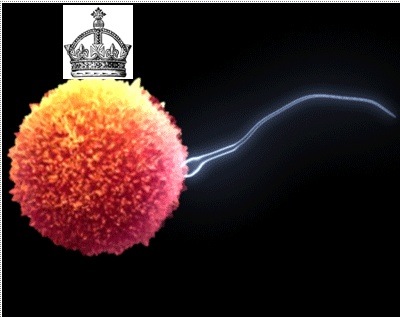
Following the wedding, a selection of at least 5 royal spermatozoa** will be extracted and fully sequenced by a specially selected team at the Royal Institution for Genetics Pedigree Studies. The secret method (which, in a nod to popular taste, does use beer as a reagent) has been designed to be maximally non-destructive.
The sequences will published on the website princesperm.gov.uk. The public will have 5 days to register and vote for the one that they prefer be invited to form their new ruler.
The elected sperm will be invited in the first instance to inseminate the royal egg. Should it fail in its attempt, the second-place sperm will be sent in. In the case of a repeat failure, a national referendum will be held to determine the correct voting procedure.
* It may be argued that this election proposal, being purely fictional and even farcical, has no bearing on the justification or not of the British monarchy. A dangerous argument indeed, for those who would dispense with fiction and farce would leave central pillars of the British constitutional order bereft of all foundation.
** Why are the future queen’s eggs not also sequenced? Choice of the ovum is a royal prerogative, cf. Blackstone, Commentaries on the Laws of England, v. 5, section 113 (Oxford 1765-1769).



 Common Infirmities