
Checks and balances and the British constitution

There is a theory that says that Britain has a unified state, with Parliament supreme, more decisive and hence less considerate of individual rights than the American state, intentionally hamstrung as it is with checks and balances. Well, that’s the theory, but I’ve long had the non-expert impression that British governance has more practical checks on government power than the US federal government has. (Federalism itself is an important check on the US government, but whether it serves or vitiates the liberty of individual citizens depends very much on the nature of the state government. Germany, with both federalism and a deep understanding of the need for limited government seems substantially better at protecting individual rights than either of the U’s.)

A case in point is the government response to the David Miranda affair. The government has gone through its whole playbook, from dismissing the incident as a routine police matter to accusing its critics of condoning terrorism. The critics, both inside and outside of government, have not been silenced. And now, it turns out there is an official “independent reviewer of terrorism legislation”, with real power to interrogate police and government officials, and report to the public.

The Guardian reports

David Anderson QC, the government’s independent reviewer of terrorism legislation, who held talks with the Met police this week, will focus on schedule 7 to the Terrorism Act of 2000, which lets police detain people at ports and airports without grounds for suspicion.

This is giving cover to the Liberal Democrats, the codependent spouse of the surveillance-addicted Tories, to withhold support for the government action. And unlike American judges, who roll over as soon as the government whispers “national security”, British judges have been willing to demand fealty to the rule of law with respect to the materials seized from Miranda:

Two judges ordered the Met and Home Office to desist from using, copying or sharing the materials until next Friday unless it were for the purpose of ensuring the protection of national security or for investigating whether Miranda was himself involved in the commission, instigation or preparation of an act of terrorism.

To the extent that the security services in the US and the UK are on a rampage to demonstrate that no one can mess with them and count on them reacting in any way reasonably or proportionately (as I argued here, and more recently Bruce Schneier argued here), this is exactly the sort of moderate, calm, institutional response that is best calculated to reestablish the authority of democratic institutions. But possibly drive the security services to lash out even more ferociously.
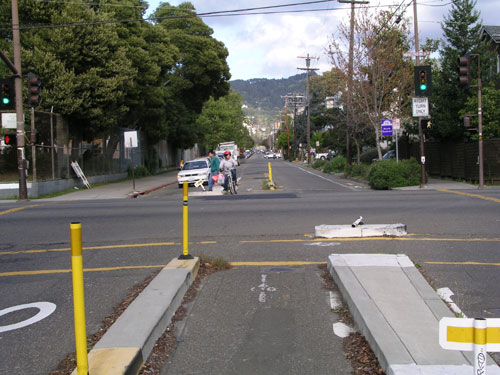
On foot and cycle in Berkeley and Oxford

Big-ChanningMLK3
Berkeley bicycle boulevard.
628x471
Wide Berkeley sidewalk.

I’ve just returned from my sabbatical in Berkeley, and while I’ve written some harsh criticism of life in the US when it unfortunately intersects with the medical system, as long as you can stay healthy there are some conspicuous advantages to life in Berkeley. Particularly if you walk or ride a bicycle.

Some of it is no one’s fault: There’s obviously more space in Berkeley for wide sidewalks, and the crush of tourists on a few major boulevards, particularly in summer, is peculiar to Oxford. On the other hand, Oxford city council chooses to allow merchants to block half of the narrow pavement with advertising signs. Still, with the narrow, often one-way streets, Oxford is no paradise for drivers either.

And maybe that’s part of the reason why Oxford drivers are, there’s no way to prettify this, hateful toward non-drivers. (Presumably toward other drivers as well, but I haven’t had that experience.) Not all of them, of course, and not all the time, but enough to make cycling something I avoid when I have time to walk, and makes me feel on edge much of the time even when I’m walking. Berkeley drivers are sometimes thoughtless, of course, but the threatening incidents of recklessness still seem less frequent in Berkeley than the incidents of active aggression and rage in Oxford.

Cycle lanes are occasional and intermittent, and the average Oxford driver considers “cycle lane” to be just a fancy word for “free parking”. We don’t have as much of a problem with restaurants or constructions sites parking their dumpsters on the cycle lanes as they apparently have in Belfast, but here’s a cheeky comment on their difficulties.

I suspect that the better conditions in Berkeley are a good example of the civilising influence of the law. California law requires that drivers stop for pedestrians in any crosswalk, whether or not it is marked. And they do. Nearly always, except on high-speed highway-like urban roads, and even there if you make yourself conspicuous you’ll usually get someone to stop pretty quickly. This gets people into the habit of paying attention to slower travellers using the road, and frequently they’ll stop even when they are not required to, for instance, for pedestrians crossing in the middle of a block, or for cyclists on a cross-street.

In Oxford, as in all of England (I have been informed), cars are required to stop only at elaborately constructed official zebra-striped crosswalks with huge flashing lights overhead. Because of the elaborate construction these are rare, and even so are often ignored. And I can certainly count on the fingers of one hand the number of times in five years that any driver has stopped to let me cross the street as a pedestrian when it was not strictly required by law. It didn’t matter if it was snowing or pouring rain and I was out walking with a small child. In Berkeley I was more likely to be embarrassed by a car stopping for me to cross when I was merely loitering near to the crosswalk.

The Home Office strikes back

The UK government has been aggressively defending its decision to interrogate Glenn Greenwald’s partner David Miranda for his links to Edward Snowden’s purloined NSA files. The Guardian reports

A Home Office spokesperson said: “The government and the police have a duty to protect the public and our national security. If the police believe that an individual is in possession of highly sensitive stolen information that would help terrorism, then they should act and the law provides them with a framework to do that. Those who oppose this sort of action need to think about what they are condoning.”

Notably lacking from this utilitarian justification is a legal justification. As I remarked here, schedule 7 of the Terrorism Act 2000, which they seem to be using as their legal framework, interrogation is permitted only to determine whether the person is a terrorist, where a “terrorist” is specifically defined as a person who “is or has been concerned in the commission, preparation or instigation of acts of terrorism.”

Absent from this list is “possessing information that would help terrorism”. The rest is just a smear, and the insinuation of what the journalists are “condoning” is just disgusting, reminiscent of the “fellow traveller” smears of the 50s.

Post-Newtonian politics, or, Psychopathology and national security

A short addendum to the comment about the seemingly counter-productive tactics of the US and European security apparatus in its attack on everyone involved in the Snowden NSA-document affair. Inspired by remarks of John Quiggin, I observed that we can’t understand what is happening when we view the state as a unitary goal-directed entity. Much of what is going on now can only be interpreted as eruptions of an internal power struggle, where the security services feel threatened, and are throwing their weight around.

Talking about throwing weight around puts one in mind of celestial mechanics. Under most circumstances we can consider planets as being simple objects, a mass located at a single point, the so-called centre of mass, whose motion is defined by a single momentum vector. It is only when we look at the fine structure, long-term behaviour, or extreme events that we need to consider the internal disposition of the mass. So it is with governments, that we may incline to see as unitary objects moved by the single will of the president or prime minister. Of course, political theorists and historians know that even the most extreme dictatorship has factions and power structures that shape the master’s will.

The analogy has been applied to the philosophy of mind. Two decades ago Philosopher Daniel Dennett introduced the definition of the self as a “center of narrative gravity”. We have intuitive models of human psychology that work, like Newton’s Laws, to predict people’s behaviour without reference to their complex inner life. Thus, if I arrange to meet you at a restaurant at 6, it suffices for me to have a few high-level beliefs about you — you want to see me, you know where the restaurant is, you have a watch — to predict that you will be there at about 6. I don’t need to concern myself with your inner life, and, in fact, for me to do so would be intrusive. It is only when behaviour becomes pathological that the unitary self loses traction.

Similarly, the pathological outbursts of the security apparatus (calling them “services” suggest that they are serving someone other than themselves, which is doubtful) force us to consider the complex power relations between government institutions.

We need to turn to some unemployed old kremlinologists to understand our own governments.

Observations on the Terrorism Act 2000 [Updated]

Despite the incredibly broad powers granted to the police by the infamous section 7 of the Terrorism Act 2000, British police seem to have managed to overstepped their authority in detaining David Miranda. They don’t need any reasonable suspicion of anything, but their actions may only be directed toward determining whether the person is a terrorist.

I’m no legal expert, but I looked at the official text of the law, and found that the paragraph of the infamous schedule 7 on “power to stop, question, and detain” begins by confining the power to a single purpose

An examining officer may question a person to whom this paragraph applies for the purpose of determining whether he appears to be a person falling within section 40(1)(b).

That paragraph, defining the people subject to detention under this act:

40 1) In this Part “terrorist” means a person who—

(b)is or has been concerned in the commission, preparation or instigation of acts of terrorism.

And yet, reports on the questioning of David Miranda say that they were not directed at linking him to any acts of terrorism, past or future:

The questions, [Miranda] said, were relentless – about Greenwald, Snowden, Poitras and a host of other apparently random subjects.

“They even asked me about the protests in Brazil, why people were unhappy and who I knew in the government,” said Miranda.

Note that the law seems (to the untrained eye) extremely specific about the permissible purpose of the detention and questioning. It is only for the purpose of determining if the person is a terrorist. Will the lawbreakers be brought to justice? Do we have to ask?

[Update 20 August, 4:30 pm] Joshua Foust has argued that, while the UK interrogation of David Miranda was regrettably extensive, they were probably legal under the Terrorism Act. I think he is confused here (though certainly I may be the one who is confused) about the distinction between the right of the police to detain someone. According to the Act,

An examining officer may exercise his powers under this paragraph whether or not he has grounds for suspecting that a person falls within section 40(1)(b).

So there is no question that they had the right to detain him, since they have the right to detain anyone at all. What is at issue is their goal, as expressed in their actions during the interrogation. So, while they don’t need any reason to think the person is a terrorist, in fact don’t even need to think that they are, and could interrogate people chosen at random, they can only do so, as stated in the section of the Act quoted above, “for the purpose of determining whether he appears to be” a terrorist. Foust suggests that threatening to expose GCHQ could count as terrorism, under the portion of the definition that includes activity that “is designed seriously to interfere with or seriously to disrupt an electronic system.” That sounds pretty far-fetched to me, but it is in keeping with the pattern that we have seen, where security officials demand sweeping powers, codified in vaguely formulated laws, and then proceed to push the boundaries of even those laws and reinterpret them (secretly) beyond all recognition.

It’s a bit like firing an employee in the US: You don’t have to have any reason, but you can’t have an illegal reason. It can be because you have indigestion, or because an angel told you to fire her, or because she’s too beautiful, but it can’t be because her skin colour clashes with your wallpaper or she’s pregnant or is in a wheelchair. And evidence for your illegal reasons are not just your explanation of the firing (or lack thereof) but other comments and actions surrounding it.

Crypto-fascism?

The word “crypto-fascist” is one of those old-left words whose day has past. In its old meaning — a right-wing authoritarian (fascist) who conceals his true views (crypto, presumably on the uncomfortable model of crypto-Catholics) — has no currency. I propose, then, that this evocative collection of phonemes be repurposed for current circumstances, to mean

Cryptological fascism. The creeping co-optation of democratic states by the cryptographer class; the authoritarian impulse arising from the déformation professionelle of professional cryptographers.

I think that after the Cameron government decided to retaliate against the family of journalist Glenn Greenwald, either for his insolence in daring to embarrass GCHQ, or at the behest of the US for embarrassing their real masters in the NSA, there can be no question that the “someday” when government surveillance and secrecy might undermine democracy is now. Secrets inevitably corrupt human relations,. The vast industry devoted to secrets has created a society within our society that cannot but hold the rest of us in contempt, even as they claim — and probably even believe — that everything they do is for our good.  That is crypto-fascism. The impulse hasn’t changed, but the power balance has been shifted massively by new technologies.

A recent blog post by economist John Quiggin reminded me of an important perspective that is easily missed, when we talk of “the US government” or “the UK government” as though they were unitary entities. He writes

It’s hard to see what kind of power can protect the security apparatus now that it is operating, to some extent in the harsh light of day. In the Snowden matter alone, the security state has trashed relations with Russia, China, and most of Latin America, as well as gravely embarrassing its UK and EU client agencies, and yet they are further than ever from getting their man… At some point, surely this must become a political liability too costly to carry.

Much of the seemingly insane thrashing of the UK and US security apparatus is surely directed internally as much as externally. They are making their legal case and their utilitarian case to the parliamentarians, for sure, most of it behind closed doors, but they are also making their we’re-crazy-as-fuck-don’t-mess-with-us play, much of which by its nature must happen in public. (Because the foolishness wastefulness of the public display is what makes the crazy convincing. It’s the handicap principle, with clandestine agencies in the role of stotting gazelles.)

And that’s exactly the argument that I made before, the danger that Obama — convinced of his own rectitude — cannot even acknowledge: The main danger of this universal surveillance is not the way it will be used to target private citizens, though that is terrible enough (and it has already begun, in the case of David Miranda). It is the way it will be used to wage power struggles within democratic government, using private information against political opponents. The question is not if it will happen, but only when.

Obama to the American people: You’re beautiful when you’re angry!

Back in 2008 I remember being amused by the accusations of arrogance levelled at then-candidate Barack Obama. It seemed to me a mere expression of anti-intellectualism. Of course you don’t become a top politician, even within reach of the presidency, without being pathologically arrogant, but no one really wants a shrinking violet as president.

But the Republican He’s a smart, educated guy, and the Republicans think (I supposed) they can gain an advantage by playing to the common fear that any such person must hold the average citizen in contempt.

I must now admit to having experienced a failure of empathy. Only now, when I (and those like me) am the object of the great BO’s contempt, do I appreciate how peculiarly infuriating this man’s ego is. This idiosyncratic blend of openness and narrow-mindedness, his willingness to discuss anything with anyone, undertaken with the absolute self-assurance that his intellect already encompasses any argument we might make.

Basically, Obama tells the American people, “You’re beautiful when you’re angry”.

In his recent remarks on l’affaire Snowden, Barry said

And if you look at the reports — even the disclosures that Mr. Snowden has put forward — all the stories that have been written, what you’re not reading about is the government actually abusing these programs and listening in on people’s phone calls or inappropriately reading people’s emails. What you’re hearing about is the prospect that these could be abused. Now, part of the reason they’re not abused is because these checks are in place, and those abuses would be against the law and would be against the orders of the FISC.

Having said that, though, if you are outside of the intelligence community, if you are the ordinary person and you start seeing a bunch of headlines saying, U.S.-Big Brother looking down on you, collecting telephone records, et cetera, well, understandably, people would be concerned. I would be, too, if I wasn’t inside the government…

But people may have better ideas and people may want to jigger slightly sort of the balance between the information that we can get versus the incremental encroachments on privacy that if haven’t already taken place might take place in a future administration, or as technologies develop further….

And so those are the kinds of things that I’m looking forward to having a conversation about.

Speaking as one of those “ordinary persons”, I am disgusted by the president offering to start a “conversation” about what I and many others who have thought deeply about these matters consider to be already huge violations of our civil liberties, an injury to the rule of law, and laying the groundwork for the complete evacuation of democracy, with the caveat right up front that the only possible result could be “to jigger slightly sort of the balance”. Because Obama the Omniscient couldn’t possibly have gotten the whole policy wrong. He’s an (adjunct) constitutional scholar, ferchrissake!

He ridicules our concerns, because we’re not well informed like the people in the “intelligence community”, but he has been withholding the information, and taking extreme measures against anyone who tries to inform us.

But he loves having these heated conversations with us. We ordinary folks are so beautiful when we’re angry!

What happens if you forget the key?

Courts in the US and the UK have recently been ruling that criminal suspects may be forced to reveal cryptographic keys that encode files that may include incriminating evidence. US courts have been divided on whether this infringes upon the otherwise absolute right to avoid self-incrimination. I’ve never taken that argument very seriously — it’s certainly not in the spirit of the right to refuse to assist in prosecuting oneself to allow people to hide documentary evidence of a crime, just because the revelation would be “speech”.  But while people may be compelled to testify in court, and in some democracies may be required to assist police by correctly identifying themselves, it’s not usual for people to be compelled by law to reveal particular information, particularly when they may not know it. While perjury charges may be brought against those who testify falsely, the inevitable unreliability of memory makes perjury convictions difficult, and I thought impossible when the subject simply pleads ignorance rather than testifying to a falsehood.

In fact, the strongest argument for a right not to reveal a password is that it’s not the hidden data that are protected by the right against self-incrimination, but rather the admission that you know the password, hence are at least in some way in control of and responsible for them, that cannot be compelled. According to the Regulation of Investigatory Powers Act 2000 (that was apparently a banner year for civil liberties in the UK), “failing to disclose an encryption key” is an offence in itself. In 2009 a man was jailed for 13 months for refusing on principle to provide encryption keys to the authorities, despite the fact that he was not suspected of any crime other than not cooperating with the police.

I have encrypted volumes on my laptop hard drive — with old exam papers — whose passwords I’ve forgotten. I probably should delete them, but I haven’t gotten around to it, and maybe I’ll remember one of these days. Even if I did delete them, they’d still be there on my hard drive unless I took exceptional measures. So if customs officials ever took an interest in my laptop while I was entering the UK, I could end up in prison for up to two years. The only thing I could do to protect myself is either to destroy the hard drive, or have it erased, which is itself suspicious.

Unlike most other criminal offences, the offence of withholding a cryptographic key is impossible to prove, but also impossible to disprove. It is even impossible for anyone but the accused even to know whether or not there has been any offence. And if there has been no criminal offence — if the accused does not, in fact, know the key — there is no way to prove that. It is the democratic state’s version of the plight of the man being tortured for information that he does not have, so that he has nothing to offer to end the suffering.

Along these lines, I was wondering about the current state of the right to silence in British law, and there came a revelation in the form of the British authorities (oddly, the news reports are all vague about which authorities it was; presumably the UK Border Agency, but maybe agents from a secret GCHQ data-mining task force) detaining the partner of journalist Glenn Greenwald under schedule 7 of the Terrorism Act 2000. According to the Guardian,

Those stopped under schedule 7 have no automatic right to legal advice and it is a criminal offence to refuse to co-operate with questioning,

This is pretty frightening, particularly when these laws are being so blatantly abused to settle political grudges.

The mistimed death clock: How much time do I have left?

Someone has set up a macabre “death clock“, a web site where individuals can enter a few personal statistics — birthdate, sex, smoking status, and general level of optimism, and it will calculate a “personal date of death”, together with an ominous clock ticking down the seconds remaining in your life. (For Americans, ethnic group is a hugely significant predictor, but I’m not surprised that they leave this out. Ditto for family income.) It’s supposed to be a sharp dose of reality, I suppose, except that it’s nonsense.

Not because no one knows the day or the hour, though that is true, but because the author has built into the calculator a common but elementary misconception about life expectancy, namely, that we lose a year of expected remaining life for every year that we live. Thus, when I enter my data the clock tells me that I am expected to die on August 6 2042. If I move my birthdate back* by 10 years — making myself 10 years older — my date of death moves back by the same amount, to August 6 2032. If I tell it I was born in 1936 it tells me that my time has already run out, which is obviously absurd.

In fact, every year that you live, you lose 1 year, but gain a proportion a remainder equivalent to the probability that you might have died. Thus, a 46-year-old US man has expected remaining lifespan 33.21 years. He has probability 0.00365 of dying in the next year; if he makes it through that year and reaches his 47th birthday, his expected remaining lifespan is (33.21-1)+.00365 x 32.21 = 32.33 years.** So he’s only lost 0.88 years off his remaining lifespan. In this way, it’s actually possible to have more expected remaining lifespan at an older age than at a younger, if the mortality rate is high enough. Thus, if we go back to 1933 mortality rates, the expected lifespan at birth was 59.2 years. But a 1-year-old, having made it through the 6.5% infant mortality, now has 62.3 years remaining on average.

This is another way of expressing the well-known but still often not-sufficiently-appreciated impact of infant mortality on life expectancy. The life-expectancy at birth for US males is 76.4 years. But that obviously doesn’t mean that everyone keels over 5 months into their 77th year. 60% of the newborn males are expected to live past this age, and a 77-year-old man has 10 remaining years on average.

Of course, these are all what demographers call “period” life expectancies, based on the mortality rates experienced in the current year, and pretending that these mortality rates will continue into the future. Based on the experience of the past two centuries we expect the mortality rates to continue to fall, in which case the true average lifespans for people currently alive — the “cohort life expectancies” will exceed these period calculations — but there is no way to know. If an asteroid hits the earth tomorrow and wipes out all life on earth, this period calculation will be rendered nugatory (but there will be no one left to point that out. Hah!) The true average lifespan of the infants born this year will not be known until well into the 22nd century. Or, if Aubrey de Grey is right, not until the 32nd century.

* Or is it moving my birthdate forward by 10 years when I make it 10 years earlier? Reasonable people disagree on this point! And there’s interesting research on the habits of mind that lead one to choose the metaphor of the stationary self with time streaming past me, or the self moving like a river through a background of time.

** Actually, it’s (33.21-1)/(1-.00365)

Dawkins’ faulty taxonomy

Science enthusiast Richard Dawkins is always good for a laugh, even if the laughter sometimes curdles at his anti-Catholic and anti-Muslim bigotry, and his inclination to minimise the the significance of child rape when it serves the interests of the former. He has recently published on Twitter the comment

All the world’s Muslims have fewer Nobel Prizes than Trinity College, Cambridge. They did great things in the Middle Ages, though.

There are all kinds of comments one could make about this, and many have, but what I find most striking is the utter failure of logic in the area that is closest to his area of purported expertise, which is not religion or sociology, but taxonomy. To a statistician, this comparison seems risible. Not only are Muslim and Member of Trinity College not comparable categories (I hope Professor Dawkins won’t get the vapours when I mention that they are not even mutually exclusive), but even if they were, Dawkins seems to be suggesting that the difference in NPF (Nobel Prize Frequency) between the devotees of Muhammed and of the Cambridge Trinity are due to negative selection by Islam, whereas another observer might suspect that there is some form of positive selection by Trinity College.

To put it baldly, you don’t need a Nobel Prize to get a post at Trinity College, but it doesn’t hurt. For example the most recent Trinity College Nobel Prize went to Venkatraman Ramakrishnan, who had a nearly 30-year scientific career before joining Trinity College.

A more valid comparison would ask, why does Trinity College, Cambridge boast so many more nobel laureates (32) than the comparably sized Trinity College, Oxford. (2, by my count from this list).  Is it the vitiating effect of Oxford’s high-church Anglicanism? Or is it that Dawkins cherry-picked one of the wealthiest, most exclusive academic institutions, one most concentrated on exactly the sorts of subjects that attract Nobel prizes? Why have Scandinavian authors received so many Nobel Prizes in Literature? Religion? Climate? Reindeer?

I leave the resolution of these questions to the skeptical reader. Those who are interested in a more amusing version of Dawkinsian taxonomy can have a look at Borges’s essay “John Wilkins’ Analytical Language“. Borges describes an imaginary ancient Chinese encyclopedia, Celestial Emporium of Benevolent Knowledge that divides up all animals into the following categories:

Continue reading “Dawkins’ faulty taxonomy”